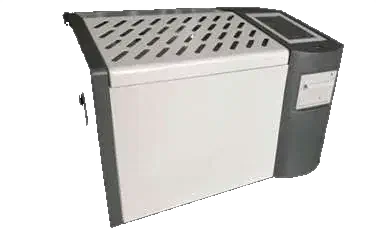
Test cell, temperature control, AC/DC sources and standard capacitor in a single automatic instrument
Measuring the dielectric dissipation factor (tanδ), relative permittivity and DC resistivity of an insulating oil to IEC 60247 takes a three-electrode cell heated to a controlled temperature, an AC source, a DC source and a stable standard capacitor. The HZJD-2Z combines all of them in one automatic instrument: it measures tanδ from 0.00001 to 100 with an accuracy of ±(1 % of reading + 0.0001), relative permittivity from 1.000 to 30.000 and DC resistivity from 2.5 MΩ·m to 20 TΩ·m, with test voltages of 500-2000 V AC and 0-500 V DC, on a sample of about 40 mL heated up to 125 °C.
HZJD-2Z key data
- Dielectric dissipation factor: the HZJD-2Z measures tanδ from 0.00001 to 100 with an accuracy of ±(1 % of reading + 0.0001) and a resolution of 0.00001.
- Permittivity and capacitance: relative permittivity from 1.000 to 30.000 with ±1 % of reading and 0.001 resolution; cell capacitance from 5 to 200 pF with ±(1 % of reading + 0.5 pF) and 0.01 pF resolution.
- DC resistivity: from 2.5 MΩ·m to 20 TΩ·m with an accuracy of ±10 % of reading.
- Test voltages: 500-2000 V RMS AC at 50 Hz and 0-500 V DC, both continuously adjustable, generated by AC-DC-AC conversion so that mains fluctuations do not affect the result, even when the instrument runs from a generator.
- Cell and temperature: three-electrode stainless-steel cell with a 2 mm gap, 60 ± 5 pF empty capacitance, empty-cell tanδ below 1 × 10⁻⁴ and about 40 mL of sample; medium-frequency induction heating with PID control from 0 to 125 °C (±0.5 °C error) and a limiting relay at 120 °C.
- Reference: three-electrode SF6 gas-filled standard capacitor whose loss and capacitance do not depend on ambient temperature or humidity.
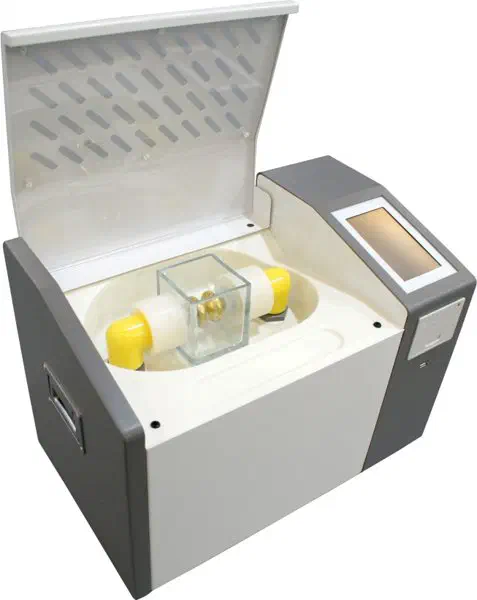
- Operation and recording: 800 × 480 colour touch screen with guided menu, automatic dry-cell calibration, built-in printer, RS-232 port and DataScan function with up to 100 date- and time-stamped records; over-voltage, over-current and high-voltage short-circuit protection.
- Standards and physical data: CE, IEC 60247, ASTM D924, ASTM D1169, GB/T 5654-2007, GB/T 507-2002, DL 429.9-91 and DL/T 846.7-2004; 220 V AC ±10 %, 50/60 Hz, 100 W; 500 × 360 × 420 mm and 22 kg; operation from 0 to 40 °C at relative humidity below 75 %.
All-in-one architecture
The instrument integrates the three-electrode test cell, the temperature controller and sensor, the dielectric-loss bridge, the AC test source, the SF6 standard capacitor, the high-resistance meter and the DC high-voltage source into a single unit. The three-electrode cell, with a 2 mm gap between the high-voltage electrode and the measuring electrode, eliminates the effect of stray capacitance and leakage on the tanδ result. The sample is heated by medium-frequency, non-contact induction with PID control that keeps the temperature within the preset error band between 0 and 125 °C, and a thermal limiting relay stops heating above 120 °C.
Applications
The instrument suits the diagnostic testing of insulating liquids wherever tanδ, permittivity and resistivity are required for acceptance or periodic checks.
- Power transformers and other critical assets.
- Substations and transmission and generation facilities.
- Oil laboratories and acceptance or maintenance testing.
Touch interface and result management
Measurement is full digital and fully automatic, run from an 800×480 full-touch colour screen with a guided menu, so any operator, without specialised training, completes a full automatic test from start to finish. The automatic test report shows the oil-cup capacitance Cx, tanδ, the relative permittivity εr and the DC resistivity ρ, with on-board printing. The DataScan function stores up to 100 records, each with the test temperature, the test voltage, the three results and the date and time, and it can recall and print them at any later moment. A built-in oil-drain control, with an on-screen confirmation prompt, empties and rinses the cell without removing it between tests.
Technical specifications
| AC test voltage | 500-2000 V, continuously adjustable, 50 Hz |
| DC test voltage | 0-500 V, continuously adjustable |
| Measured temperature range | 0-125 °C, ±0.5 °C error |
| HV-LV electrode gap | 2 mm |
| Dimensions (W×D×H) | 500 × 360 × 420 mm |
| Weight | 22 kg |
| Power supply | AC 220 V ±10%, 50/60 Hz, 100 W |
| Standards | IEC 60247, ASTM D924, ASTM D1169, GB/T 5654-2007 |
| Dielectric dissipation factor (tanδ) | 0.00001-100; accuracy ±(1 % of reading + 0.0001); resolution 0.00001 |
| Relative permittivity / capacitance | 1.000-30.000, ±1 % of reading, resolution 0.001 / 5-200 pF, ±(1 % of reading + 0.5 pF), resolution 0.01 pF |
| DC resistivity | 2.5 MΩ·m-20 TΩ·m; accuracy ±10 % of reading |
Frequently asked questions
How accurate is the HZJD-2Z for tanδ and resistivity?
The HZJD-2Z measures tanδ from 0.00001 to 100 with ±(1 % of reading + 0.0001) and 0.00001 resolution, relative permittivity from 1.000 to 30.000 with ±1 % and DC resistivity from 2.5 MΩ·m to 20 TΩ·m with ±10 % of reading. The empty cell has an intrinsic tanδ below 1 × 10⁻⁴.
Can it run from a generator in the field?
Yes. The HZJD-2Z generates its test voltages by AC-DC-AC conversion, so mains voltage and frequency fluctuations do not affect the measurement and the instrument works correctly from a generator. It needs 220 V AC ±10 %, 50/60 Hz, and draws 100 W.
What does the HZJD-2Z measure in a single test?
The dielectric loss factor (tanδ), relative permittivity and DC resistivity of the sample, all with the same three-electrode cell.
How much oil sample does it need?
About 40 mL, poured into the cell after the dry-cell calibration, letting bubbles settle for over 15 minutes.
Does it require specialised training?
No. The guided menu on the touch screen walks the operator through calibration, filling and the automatic test step by step.
How are the results kept?
With the DataScan function, which stores up to 100 records with date and time and can recall and print them from the instrument itself.