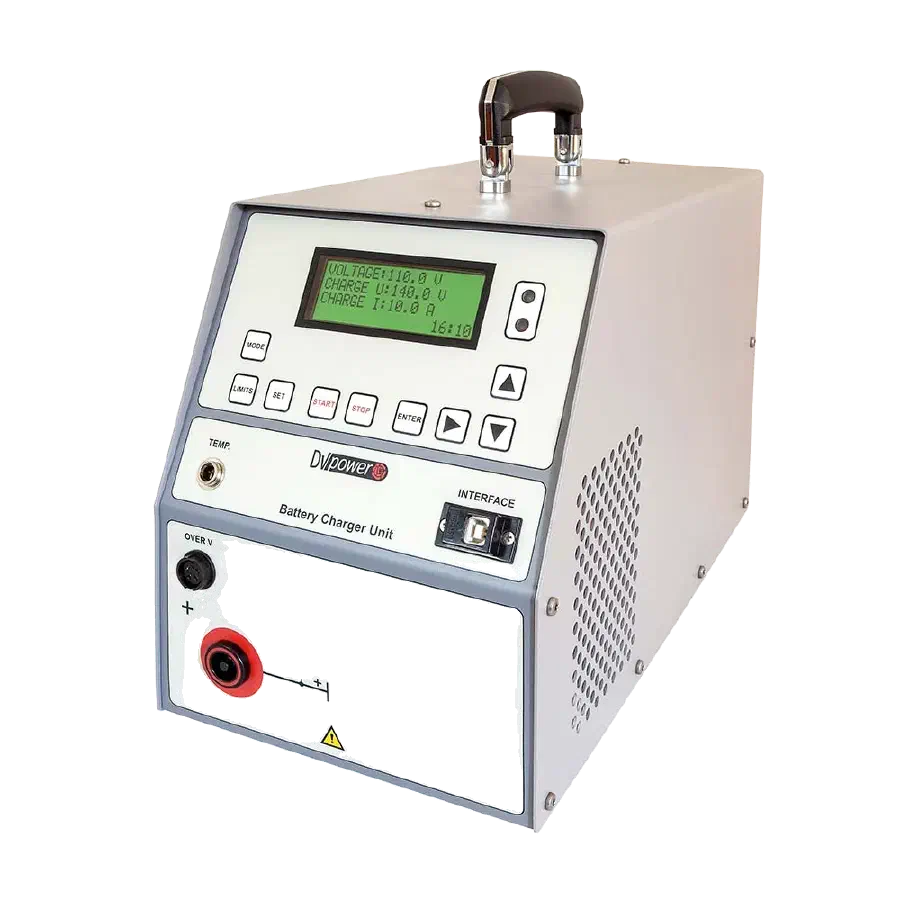
Portable battery charger up to 300 V and 50 A DC in 10 kg, to recharge stationary banks without disconnecting the installation
Recharging a stationary battery bank quickly after a discharge test, or backing up the main charger without disconnecting the installation, calls for a portable charger with regulated charging and adjustable alarm and shutdown levels. BAC 25A-50L does it with two 10 kg models: the BAC25A charges strings from 10 to 300 V DC with up to 25 A and 2.7 kW, and the BAC50L from 1 to 60 V DC with up to 50 A and 2.5 kW, both in IU mode (constant current, then constant voltage) or UU mode (constant voltage with a current limit), for lead-acid, Ni-Cd and Li-ion.
BAC 25A-50L key data
- Charging range: BAC25A from 10 to 300 V DC, up to 25 A DC and 2.7 kW; BAC50L from 1 to 60 V DC, up to 50 A DC and 2.5 kW. Same weight, handling and accessories on both models.
- Charging modes: IU, constant current finishing at constant voltage, with cut-off when the predefined minimum current is reached; and UU, constant voltage with a current limit. Adjustable alarms and shutdown in both.
- Accuracy and resolution: voltage with ±(0.25 % of reading + 0.25 % of full scale) typical accuracy; current and voltage displayed and adjustable with 0.1 A and 0.1 V resolution on the LCD screen.
- Temperature compensation: PT100 ambient temperature probe that compensates the float voltage.
- Protections: thermal, overcurrent, overvoltage and undervoltage, for both the battery and the charger itself; external alarm terminals and USB interface.
- Applications: standby batteries in power plants and substations, 110 or 220 V DC protection and control systems, UPS strings, generator excitation and fast recharge after discharge tests.
- Portable: 10 kg and 417 × 202 × 301 mm; 90 to 264 V AC, 50/60 Hz supply, up to 3300 VA; connected with two current cables from 3 to 20 m, with optional voltage sense cables.
Advantages
Two regulated charging modes
The IU mode charges at constant current and finishes at constant voltage; the UU mode holds a constant voltage with a current limit. In both cases the regulation shortens the recharge and lowers the risk of overcharging.
Charging watched from start to finish
Alarm and shutdown parameters are adjustable, and the thermal, overcurrent, overvoltage and undervoltage protections look after the battery and the instrument at the same time.
Real-time information
The LCD screen shows voltage, current and status throughout the process and lets the user trim the charging current or time on the fly, with a resolution of 0.1 A and 0.1 V.
Best power-to-weight ratio
Weighing 10 kg with up to 2.7 kW of output, the unit is carried to the battery room with one hand and hooked up with two current cables; the voltage sense cables are optional.
Applications
- Standby batteries in power plants and substations.
- Generator excitation systems.
- Protection and control systems fed at 110 or 220 V DC.
- UPS battery strings.
- Fast recharge after discharge tests with load units.
About the product
The BAC25A works from 10 to 300 V DC with up to 25 A and 2.7 kW; the BAC50L covers 1 to 60 V DC with up to 50 A and 2.5 kW. Both run from 90 to 264 V AC, with a voltage accuracy of ±(0.25% + 0.25%), a PT100 temperature probe, a USB interface and external alarm terminals. Accessories: current cables from 3 to 20 m, sense cables, alarm cables, cable bag and transport bag.
Technical specifications
| Models | BAC25A and BAC50L |
| Battery voltage | 10 – 300 V DC (BAC25A); 1 – 60 V DC (BAC50L) |
| Maximum current | 25 A DC (BAC25A); 50 A DC (BAC50L) |
| Maximum power | 2.7 kW (BAC25A); 2.5 kW (BAC50L) |
| Charging modes | IU and UU, with adjustable alarms and shutdown |
| Measurement resolution | 0.1 A and 0.1 V |
| Mains supply | 90 – 264 V AC, 50/60 Hz; up to 3300 VA |
| Dimensions and weight | 417 × 202 × 301 mm; 10 kg |
| Voltage accuracy | ±(0.25 % rdg + 0.25 % FS) typical |
| Temperature compensation | PT100 probe for the float voltage |
Frequently asked questions
Which charger can recharge 110 or 220 V DC substation batteries after a capacity test?
A portable one that covers the string voltage with enough current and an automatic cut-off. The BAC25A charges strings from 10 to 300 V DC with up to 25 A and 2.7 kW, so it covers 110 and 220 V DC banks; it connects alongside the main charger without switching it off and, in IU mode, cuts off at the predefined minimum current.
Which charger suits a low-voltage bank that needs a lot of current, such as a 48 V bank?
The BAC50L, which works from 1 to 60 V DC with up to 50 A and 2.5 kW in the same 10 kg unit. It regulates voltage with ±(0.25 % of reading + 0.25 % of full scale) typical accuracy and compensates the float voltage with its PT100 probe.
Does it replace the installation's main charger?
No: it complements it. There is no need to switch the main charger off; the BAC connects alongside it to speed up the recharge or to restore a bank after a discharge test.
Which battery types does it accept?
Lead-acid, Ni-Cd and Li-ion strings. With its two charging modes it can also maintain or recharge any string type within its voltage range.
How is overcharging prevented?
Through the adjustable alarm and shutdown levels: in IU mode the cut-off comes when the predefined minimum current is reached, and the internal protections watch temperature, current and voltage.
What sets the BAC25A and the BAC50L apart?
Only the range: the BAC25A reaches 300 V with up to 25 A, while the BAC50L favours current, with 50 A up to 60 V. Weight and handling are identical.