Battery chargers and rectifiers
Showing 5 of 5
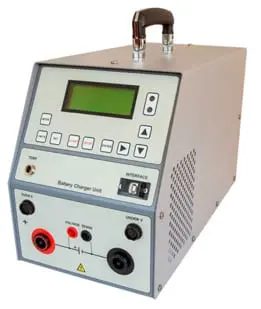

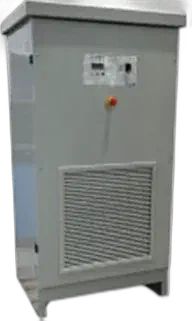
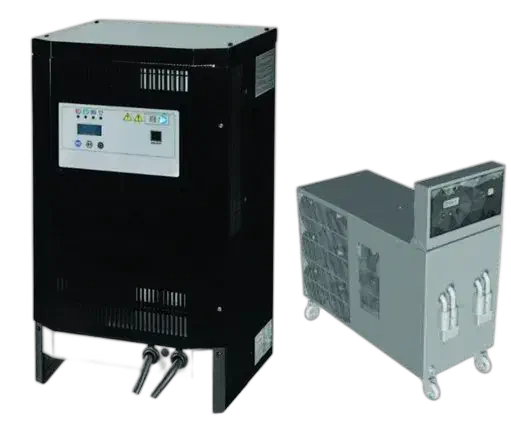
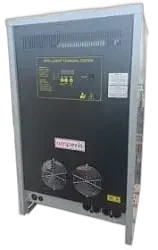
Battery chargers and rectifiers keep the stationary banks that feed DC auxiliary services alive: protection relays, telecontrol, breaker operating motors and emergency lighting. They convert the AC supply into a stabilised DC voltage that carries the standing load and holds the battery on float, ready for a mains failure.
What do they do and how?
A charger-rectifier feeds the DC busbar and the battery at the same time. It regulates the float voltage tightly — a sustained deviation accelerates grid corrosion or sulphation — and applies controlled equalising charges. Typical substation systems run at 110 or 125 V DC with current limiting and alarms for mains failure, charger failure and earth faults on the bus.
How to choose the right unit
- Bank voltage and capacity: size charger current to recharge after a duty-cycle discharge while carrying the permanent load.
- Battery chemistry: vented lead-acid, VRLA and Ni-Cd each need different float setpoints.
- Range: the BAC family covers stable industrial charging; MMF and MMF-ASR offer multifunction formats; the multi-voltage charger adapts to banks of different voltages; HPS stations provide high-voltage DC fast charging.
- Redundancy: critical substations duplicate chargers on the same bank.
Unsure about sizing? Send bank voltage, Ah capacity and loads to info@amperis.com.
Applications
- DC auxiliary services in transmission and distribution substations.
- Starting and control systems in power plants.
- Industrial UPS, telecom sites and control rooms.
Applicable standards
- IEC 60146-1-1: semiconductor converters (rectifiers).
- IEEE 485: sizing of stationary lead-acid batteries.
- IEEE 450 / IEEE 1188: maintenance and testing of vented and VRLA batteries.
Frequently asked questions
What is the difference between float and equalise?
Float is the permanent voltage that offsets self-discharge without gassing; equalise is a temporary higher-voltage charge that rebalances cells after deep discharges or drift between cells.
Why does output-voltage stability matter so much?
A float a few percent high gasses and dries the battery; a few percent low lets it sulphate and lose capacity. Substation chargers therefore regulate with temperature compensation and deviation alarms.
How do you prove the system still performs?
With periodic capacity discharges using battery dischargers and measurements with battery testers, per IEEE 450/1188.
Resources and contact
Full family under battery maintenance and charging. Quotations: info@amperis.com · +34 982 20 99 20.
Battery charger and discharger selector Enter your battery's chemistry, voltage and capacity and get the charger, discharger or regeneration set that covers your specification. You can send us the selection with the technical report attached. Open the selector and find my equipment Close the selector
Undecided between several models? Compare them side by side: Battery discharge testers compared · Battery chargers and rectifiers compared · Battery testers compared