BAC: industrial battery charger
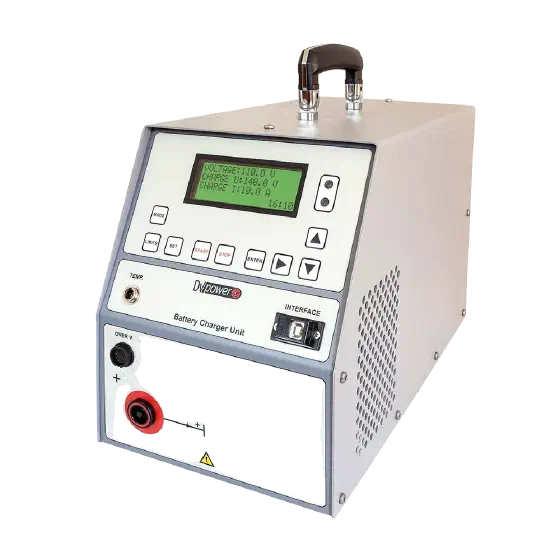
BAC battery chargers are portable, universal chargers for stationary lead-acid, Ni-Cd and Li-ion battery strings from 1 to 300 V DC. They do not replace the site’s fixed rectifier: they complement it to shorten a recharge or to put energy back into a bank straight after a discharge test, without disconnecting the auxiliary services. The series has two models, the BAC25A and the BAC50L, in the same 10 kg format.
What do they do and how?
The BAC is connected in parallel to the bank with two current cables (voltage sense leads are optional) and charges in one of two regulated modes. In IU mode it charges at constant current and finishes at constant voltage, stopping when the preset minimum current is reached; in UU mode it holds a constant voltage with a current limit. The LCD shows voltage, current and status throughout, with 0.1 A and 0.1 V resolution, and lets the operator adjust current or time on the fly. Thermal, overcurrent, overvoltage and undervoltage protection, together with adjustable alarm and shutdown thresholds and a PT100 temperature probe, protect both the battery and the charger.
How to choose the right unit
- Bank voltage: the BAC25A works from 10 to 300 V DC, covering the 110, 125 and 220 V DC banks common in substations and power plants.
- Charging current: the BAC50L favours current, with up to 50 A between 1 and 60 V DC, for low-voltage, high-capacity banks.
- Power: 2.7 kW (BAC25A) and 2.5 kW (BAC50L) from a 90–264 V AC supply.
- Chemistry: check your battery’s float and end-of-charge values; the two modes cover lead-acid, Ni-Cd and Li-ion.
- Connection and logging: USB interface, external alarm terminals and current cables from 3 to 20 m.
Full data on the BAC 25A-50L page. Not sure which model? Send us the bank voltage and capacity through our contact form.
Applications
- Back-up batteries in substations and power plants.
- Fast recharge after capacity tests with battery dischargers.
- Protection and control systems supplied at 110 or 220 V DC.
- Generator excitation systems and UPS battery strings.
Applicable standards
- IEEE 450: maintenance, testing and replacement of vented lead-acid batteries.
- IEEE 1188: maintenance and testing of VRLA batteries.
- IEC 60896-11 / 60896-21: stationary lead-acid batteries.
Frequently asked questions
Does the main charger have to be switched off?
No. The BAC is connected in parallel to the bank while the fixed rectifier keeps supplying the DC bus, so the installation stays in service during the recharge.
Why recharge straight after the discharge test?
A discharged bank leaves the site without reserve if the mains fails. Adding the BAC’s current to that of the fixed charger shortens that exposure time.
How is overcharging prevented?
With adjustable alarm and shutdown thresholds, the minimum-current cut-off in IU mode and the internal temperature, current and voltage protection.
Resources and contact
See the full range of battery chargers and rectifiers, the battery testers and the battery maintenance and charging family. Quotations: info@amperis.com · +34 982 20 99 20.
Related calculator
- Sizing, autonomy and capacity test IEEE 485-2020 · IEEE 450-2020 · IEC 60896-21:2004 · IEC 61056-1:2012
- Battery life forecast: state of health (SOH) and remaining life calculator IEEE 450-2020 · IEEE 1188-2005 · IEEE 2962-2025 · IEC 60896
Battery charger and discharger selector Enter your battery's chemistry, voltage and capacity and get the charger, discharger or regeneration set that covers your specification. You can send us the selection with the technical report attached. Open the selector and find my equipment Close the selector
Undecided between several models? Compare them side by side: Battery discharge testers compared · Battery chargers and rectifiers compared · Battery testers compared