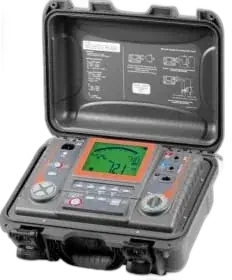
Measuring the insulation of transformers, generators and medium-voltage cables next to live high-voltage equipment takes a 5 kV meter that withstands induced voltages without aborting the test and reaches the teraohm range. The AMIC-5010 keeps measuring with interference voltages below 50 V DC or 500 V AC, stabilises the reading with 10, 30 or 60 s digital filters and covers 50 kΩ to 15 TΩ per IEC 61557-2, with ±(3% m.v. + 10 digits) up to 99.9 GΩ, PI, DAR, SV and DD indices and a 200 mA continuity test per EN 61557-4.
AMIC-5010 key data
- Test voltage and current: the AMIC-5010 sets 50 to 1000 V in 10 V steps and 1 to 5 kV in 25 V steps, with a test current of 1.2 or 3 mA and a maximum short-circuit current of 3.6 mA ±15%.
- Range and accuracy: up to 500 GΩ at 250 V, 1 TΩ at 500 V, 2 TΩ at 1000 V, 5 TΩ at 2500 V and 15 TΩ at 5000 V; at 5 kV, ±(3% m.v. + 10 digits) up to 99.9 GΩ and ±(10% m.v. + 10 digits) from 10 to 15 TΩ.
- Interference immunity: with interference voltages below 50 V DC or 500 V AC the test continues with additional uncertainty; 10, 30 or 60 s digital filter and three-lead measurement with the G terminal adding only 0.05% error.
- Diagnostics: t1, t2 and t3 times from 1 to 600 s for DAR/PI or Ab1/Ab2, total time up to 99 min 59 s, SV in five steps of 30 s to 5 min, DD with 1 to 60 min charging and a minimum RISO limit adjustable from 1 kΩ to 15 TΩ.
- Continuity: 0.12…999 Ω per EN 61557-4 with 200…250 mA in both directions, ±(2% m.v. + 3 digits) up to 199.9 Ω and ±(4% m.v. + 3 digits) up to 999 Ω, with test-lead autozeroing.
- Leakage current and capacitance: leakage current from 0.01 nA with ±(1.5% m.v. + 2 digits) and capacitance from 1 nF to 49.99 µF with ±(5% m.v. + 5 digits).
- Battery and environment: 13.2 V, 5.0 Ah LiFePO4 battery for at least 1000 RISO measurements per EN IEC 61557-2, 990-cell memory (11 880 records), operation from -20 to +50 °C up to 3000 m.
Advantages
Fine-stepped voltage up to 5 kV
The test voltage is set from 50 to 1000 V in 10 V steps and from 1 to 5 kV in 25 V steps, with test currents of 1.2 or 3 mA that charge large objects quickly and a range that reaches 15 TΩ at 5 kV.
Measures where others cannot
Unique algorithms recognise the nature of the voltage present on the object: mains voltage blocks the test, while voltage induced by electromagnetic fields does not — so measurements succeed next to live HV equipment, helped by 10, 30 and 60 s digital filters.
Complete time diagnostics
T1, T2 and T3 times from 1 to 600 s deliver the absorption coefficients, PI and DAR, the step-voltage test (SV) and the dielectric discharge (DD) complete the picture, and capacitance and leakage current are read during the test.
Safe accessories up to 11 kV
The supplied leads withstand 11 kV and the probes and crocodile clips 5.5 kV; leads up to 20 m can be used thanks to the high interference immunity, and the object is always discharged after the test.
Applications
- Insulation diagnostics of transformers, motors and generators.
- Medium-voltage cables and switchgear in substations.
- Measurements near live busbars and in strong electromagnetic fields.
About the product
The AMIC-5010 is a 5 kV insulation meter whose range — 50 kΩ to 15 TΩ — and interference immunity up to 500 V place it in the premium class. Basic accuracy is ±(3% m.v. + 10 digits), the timer runs to 99'59'' and adjustable limits qualify each result; a mobile app shows live graphs on an Android device.
It is powered from a LiFePO4 13.2 V battery or from the 90-260 V mains, performs at least 1000 measurements per EN 61557-2 on one charge, and its case reaches IP67 when closed (IP40 open). Safety follows EN 61010-1 with CAT IV 600 V (CAT III 1000 V) and double insulation.
Available accessories: 3 m, 11 kV leads, 11 kV probes and crocodile clips, mains cable, carrying case, USB cable and calibration certificate; optionally 15 kV leads up to 20 m, the PRS-1 probe and the CS-1 simulator.
Technical specifications
| Test voltage | 50…5000 V; 10 V steps to 1 kV, 25 V steps above |
| Measuring range | 50 kΩ…15 TΩ per IEC 61557-2 (UISO = 5 kV) |
| Test current | 1.2 mA or 3 mA |
| Diagnostics | PI, DAR, Ab1, Ab2, SV, DD; timer up to 99'59'' |
| Digital filters | 10 / 30 / 60 s; immunity up to 500 V |
| Continuity | >200 mA per EN 61557-4; 0.12…999 Ω |
| Memory and interface | 990 cells (11 880 records); USB and Bluetooth |
| Safety | CAT IV 600 V (CAT III 1000 V); IP67 (case closed) |
| Accuracy by sub-range (5 kV) | ±(3.5% m.v. + 10 digits) up to 999 GΩ; ±(7.5% m.v. + 10 digits) up to 9.99 TΩ; ±(10% m.v. + 10 digits) up to 15 TΩ |
| Continuity accuracy | ±(2% m.v. + 3 digits) up to 199.9 Ω; ±(4% m.v. + 3 digits) up to 999 Ω |
| Leakage current and capacitance | From 0.01 nA, ±(1.5% m.v. + 2 digits); 1 nF…49.99 µF, ±(5% m.v. + 5 digits) |
Frequently asked questions
What interference voltage can the AMIC-5010 tolerate without stopping the test?
The AMIC-5010 keeps measuring if the object carries less than 50 V DC or 500 V AC of interference voltage, with additional uncertainty; above those values it blocks the test and lights the red LED. The 10, 30 or 60 s digital filters stabilise the reading in noisy environments.
How accurate is the continuity test of the AMIC-5010?
It measures from 0.12 to 999 Ω per EN 61557-4 with 200 to 250 mA in both directions, with ±(2% m.v. + 3 digits) up to 199.9 Ω and ±(4% m.v. + 3 digits) up to 999 Ω; the open-circuit voltage is 4 to 24 V and the leads are compensated by autozeroing.
What range corresponds to each test voltage?
500 GΩ at 250 V, 1 TΩ at 500 V, 2 TΩ at 1000 V, 5 TΩ at 2500 V and 15 TΩ at 5000 V, following the RISO limits of IEC 61557-2.
How does it measure under strong interference?
Its algorithms distinguish mains voltage from voltage induced by electromagnetic fields and the digital filters average over 10, 30 or 60 s, so tests can run next to energised equipment.
Which diagnostic indices does it calculate?
The polarization index (PI), the dielectric absorption ratio (DAR), the Ab1 and Ab2 coefficients, step-voltage tests (SV) and the dielectric discharge (DD).
Can it check protective conductors?
Yes. It tests continuity with a bidirectional current above 200 mA per EN 61557-4, with autozeroing and compensation of the test leads.