Transformer winding ohmmeters
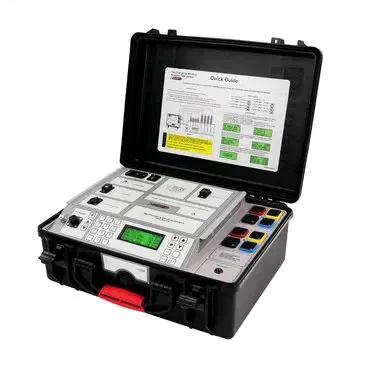
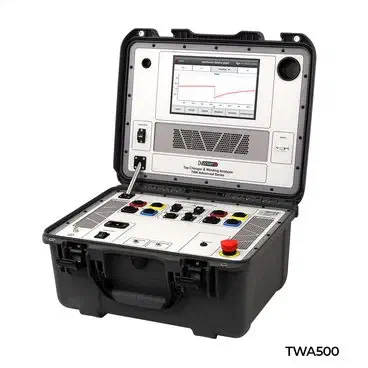
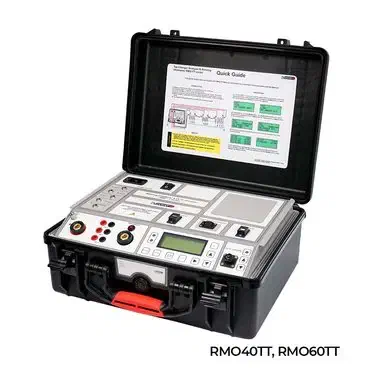
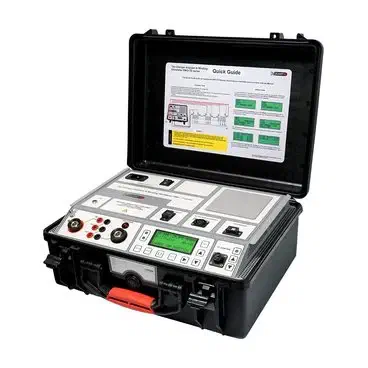
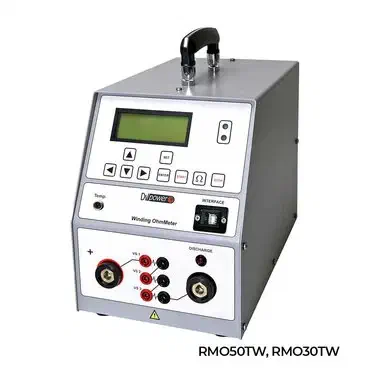
Winding ohmmeters measure the DC resistance of transformer, motor and generator windings with micro-ohm resolution. They uncover shorted turns, loose connections, broken strands and tap-changer trouble — defects an ordinary multimeter cannot see.
What do they measure and how?
The instrument injects a stabilised DC current into the winding, waits for the inductance to saturate and reads the voltage drop through a four-wire (Kelvin) connection that cancels lead resistance. Readings are compared between phases and against factory values: IEC 60076-1 expects only small deviations between phases, so a growing spread points to a defect. After testing, the set demagnetises the core automatically.
How to choose the right unit
- Test current: higher current shortens stabilisation on large transformers; the TWA standard and TWA advanced series cover both needs.
- Channels: measuring two windings at once (RMO-TW series) halves field time.
- Tap-changer testing: RMO-TD series record continuity through the OLTC transition (IEC 60214-1).
- Combined verification: the ROM-TT series add turns-ratio measurement in the same instrument.
Send the transformer rating and vector group to info@amperis.com for guidance.
Applications
- Maintenance and diagnostics of power and distribution transformers.
- Motor and generator checks in industry and renewables.
- Quality control after repairs and rewinds.
Applicable standards
- IEC 60076-1: transformer winding resistance.
- IEC 60214-1: on-load tap-changers.
- IEEE C57.152: field diagnostics of transformers.
Frequently asked questions
Why a four-wire measurement?
A winding can measure just a few milliohms: with two wires, leads and clamps would dominate the reading. The Kelvin connection measures only the drop across the winding itself.
How long does a measurement take?
It depends on inductance: on large transformers the current needs minutes to stabilise. Higher test currents and simultaneous two-winding measurement shorten the job.
Is demagnetising afterwards necessary?
Yes. DC testing magnetises the core, which can cause high inrush at energisation and distort later tests; the range therefore includes automatic demagnetisation.
Resources and contact
Related: transformer ratio meters and the full transformer testing family. Quotations: info@amperis.com · +34 982 20 99 20.