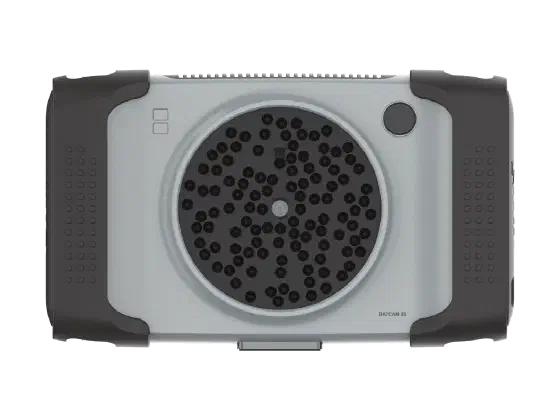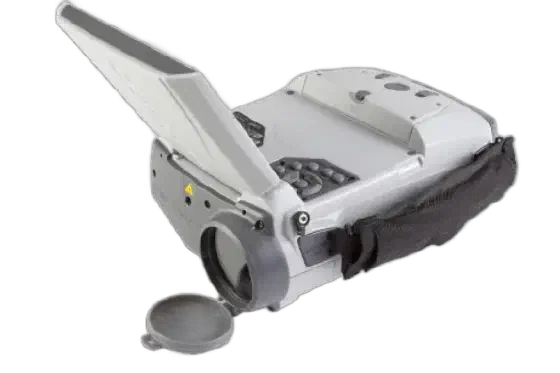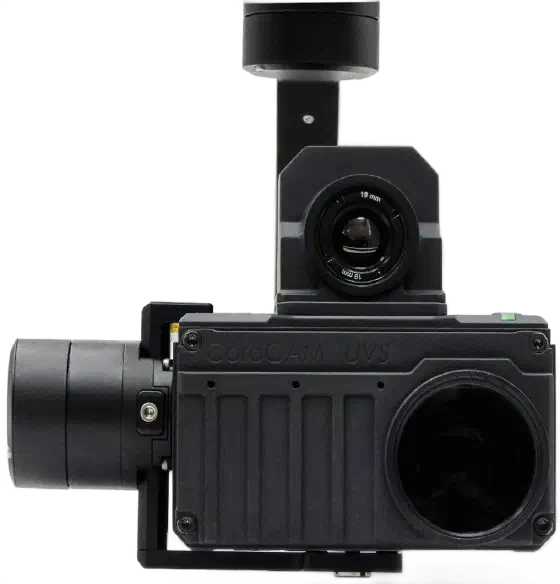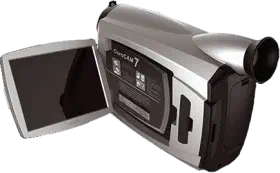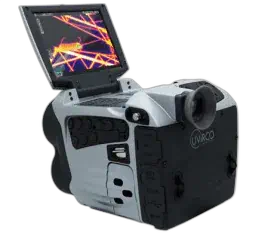
The CoroCAM 8HD combines a solar-blind ultraviolet channel with a radiometric thermal camera, locating corona discharges and hot spots on a high-voltage installation in a single pass.
Advantages
Dual diagnosis in a single inspection
By integrating the ultraviolet channel with a radiometric thermal camera, the CoroCAM 8HD locates partial discharges and hot spots together, giving the inspector more information about the cause of an anomaly without repeating the inspection with two separate instruments.
High-resolution thermal channel
The vanadium-oxide microbolometer detector covers the 7.5 to 13.5 µm spectral band, measures from -40°C to 160°C with an NEdT sensitivity below 62.5 mK, and provides 640×512 pixels with 15 configurable colour palettes and isotherms.
High-sensitivity ultraviolet channel
It detects emissions of up to 2.05×10⁻¹⁸ W/cm² (3 pC at 20 m), with an optional non-solar-blind mode of approximately 1×10-18 W/cm² (0.8 pC at 15 m) for indoor or night-time inspection.
Zoom synchronised across all three channels
The 30x optical zoom of the visible channel is synchronised with the digital zoom of the ultraviolet and infrared channels, so all three always show the same framing at the requested resolution.
Applications
- Joint inspection of corona discharges and hot spots in high-voltage substations.
- Root-cause diagnosis of faults involving both corona effect and heating.
- High-demand predictive maintenance carried out by professional inspectors.
- Technical documentation with environmental data linked to each measurement.
About the product
The one-handed rotating grip and multi-function keypad switch between ultraviolet+visible, ultraviolet+infrared, or each channel on its own, with colour overlay configurable in 6 preset combinations or 100 user hues. Focus on the visible and infrared channels is automatic or manual, and the ultraviolet channel can be synchronised with either of the other two.
The body houses a fold-out 5.7-inch LCD display and an 800×600 viewfinder with a ventilated rubber eyepiece, internal GPS, an adjustable-brightness LED flashlight and a laser pointer. Still images, video and radiometric data (UCF format) are recorded to a 64 GB or larger microSD card, with IP43 protection and a weight of 2.5 kg with battery. To place captures on drawings in UTM or ED50, the coordinate converter converts the position given by the GPS.
Accessories available: CoroBASE reporting software, neckstrap and camera harness.
Technical specifications
| Thermal channel | VOx microbolometer, 7.5-13.5 µm, -40°C to 160°C, NEdT < 62.5 mK, 640×512 px |
| UV sensitivity | SB 2.05×10⁻¹⁸ W/cm² (3 pC at 20 m); optional NSB ~1×10-18 W/cm² (0.8 pC at 15 m) |
| Visible channel | 1920×1080 px; 30x optical zoom; IFOV 0.01917 mrad |
| Thermal palettes | 15 palettes with isotherms; automatic or manual level and span |
| Connectivity | Internal GPS, Ethernet, USB, RS-232, composite video |
| Storage | microSD ≥ 64 GB; JPG, 720p AVI and UCF radiometric data |
| Protection & weight | IP43; 2.5 kg with battery; 215×200×155 mm |
| Warranty | 12 months |
Frequently asked questions
What does combining the ultraviolet and thermal cameras provide?
It locates corona discharges and hot spots in the same image, giving more context on the cause of a fault without needing two separate inspections.
What temperature range does the thermal channel measure?
From -40°C to 160°C, with an NEdT sensitivity below 62.5 mK and 15 configurable colour palettes with isotherms.
Can the environmental context of each measurement be logged?
Yes, alongside the images and radiometric data, distance, air temperature and pressure, relative humidity and wind speed can be entered manually.
How are the three channels synchronised when zooming?
The visible channel's optical zoom is combined with the digital zoom of the ultraviolet and infrared channels, so all three keep the same framing.