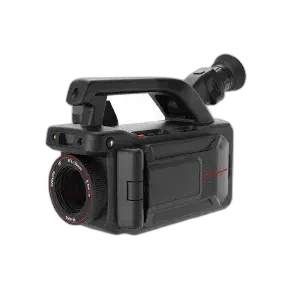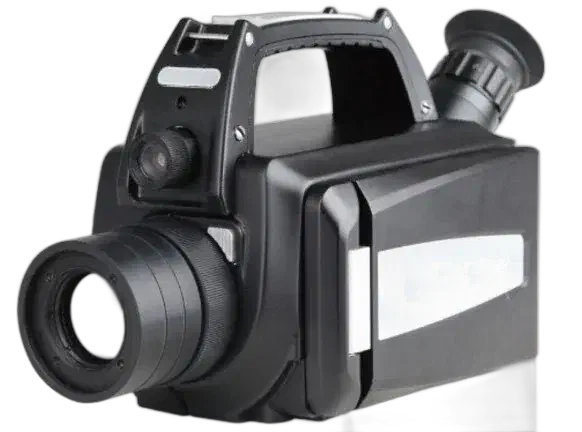
Seeing methane (CH4) and other VOC leaks takes an optical gas imaging camera with a cooled detector working in the 3.2-3.5 µm band, where these gases absorb strongly, and a rating for explosive atmospheres. The TC721 meets both: its cooled 320 × 256 quantum-well detector, with NETD ≤ 0.015 °C at 30 °C and a gas detection sensitivity of 0.4 g/h of CH4 at 2 m, shows the escape as a live plume from up to 80 m, and its Ex ic nC op IIC T4 Gc rating admits it into petrochemical and gas facilities.
TC721 key data
- Gas detection: 3.2-3.5 µm band (VOC absorption), gas detection sensitivity of 0.4 g/h of CH4 at 2 m and leak location from up to 80 m with the installation in service.
- Detector: cooled 320 × 256 quantum-well, NETD ≤ 0.015 °C at 30 °C and 60 Hz, with standard and multi-level high-sensitivity detection modes.
- Visible gases: dozens of volatile organic compounds, among them methane (CH4), ethane, propane, butane, pentane and hexane.
- Explosive atmospheres: Ex ic nC op IIC T4 Gc rating for potentially explosive gas environments.
- Optics: 14.5° × 10.8° field of view, 0.5 m minimum focus and 0.79 mrad IFOV, with automatic, motorised or manual focus.
- Temperature measurement: −40 °C to +500 °C with ±2 °C or ±2 % of reading accuracy (whichever is greater).
- Documentation: 5 MP CMOS visible camera with LED light, 14-bit radiometric JPEG and MPEG-4 video on an expandable 32 GB SD card, 60 s voice and text notes, GPS, 635 nm laser pointer, Wi-Fi and Bluetooth.
- In the field: lithium battery with 4 h runtime and on-unit charging, power-on in under 7 min, operation from −20 °C to +50 °C and IP54.
Advantages
Inspection without shutdowns
The camera relies on passive infrared imaging within the 3.2-3.5 µm band, where the target gases absorb strongly. Energised electrical equipment can be inspected from up to 80 m and kept in service throughout the survey.
Cooled detector for faint leaks
The cooled 320 × 256 quantum-well detector provides a thermal sensitivity (NETD) of ≤ 0.015 °C at 30 °C, revealing plumes that a conventional thermal camera would miss. Two detection modes are available, standard and multi-level high sensitivity, so the same instrument also covers routine infrared temperature checks.
Broad VOC coverage
Dozens of volatile organic compounds can be visualised, among them methane (CH4), ethane, propane, butane, pentane and hexane.
Certified for hazardous areas
The Ex ic nC op IIC T4 Gc rating admits the camera into the potentially explosive atmospheres common to petrochemical and gas facilities.
Complete field documentation
A 5 MP visible camera, radiometric image and video storage, and voice and text annotation allow full survey reports to be produced on site.
Applications
- Leak surveys around energised substations and switchgear.
- Petrochemical, oil-and-gas and natural-gas facilities.
- Chemical and process plants handling combustible hydrocarbons and VOCs.
About the product
The TC721 is intended for early, non-contact detection of fugitive emissions. Findings are documented with radiometric images and video, complemented by the built-in visible camera and voice or text notes for complete field reports.
Technical specifications
| Detector | Cooled quantum-well, 320 × 256 |
| Spectral range | 3.2-3.5 µm (VOC absorption band) |
| Thermal sensitivity (NETD) | ≤ 0.015 °C at 30 °C |
| Working distance | Leaks located from up to 80 m |
| Hazardous-area rating | Ex ic nC op IIC T4 Gc |
| Detectable gases | Methane (CH4), ethane, propane, butane, pentane, hexane and other VOCs |
| Gas detection sensitivity | 0.4 g/h of CH4 at 2 m |
| Field of view / IFOV | 14.5° × 10.8° (min. focus 0.5 m); 0.79 mrad; 60 Hz |
| Power supply and environment | Lithium battery, 4 h; −20 °C to +50 °C; IP54 |
Frequently asked questions
Which camera can see methane and other VOC leaks?
An OGI camera with a cooled detector in the 3.2-3.5 µm band. The TC721 has a cooled 320 × 256 quantum-well detector with NETD ≤ 0.015 °C and detects 0.4 g/h of CH4 at 2 m; besides methane it visualises ethane, propane, butane, pentane, hexane and dozens of other VOCs from up to 80 m.
How long does it take to be ready, and how long does the battery last?
The TC721 powers on in under 7 min and its rechargeable lithium battery provides 4 h of continuous operation, charging on the unit. It operates from −20 °C to +50 °C with IP54 protection.
What is optical gas imaging (OGI)?
A passive infrared technique that reads the radiation absorbed by gases within a narrow spectral window (3.2-3.5 µm), so an escape appears as a live plume on screen.
Can energised electrical equipment be inspected?
Yes. Leaks are located from up to 80 m without taking the equipment out of service.
Is the camera suitable for explosive atmospheres?
Yes. It is certified Ex ic nC op IIC T4 Gc for use in potentially explosive gas environments.
How are findings documented?
With radiometric image and video storage, a 5 MP visible camera and voice or text annotation.