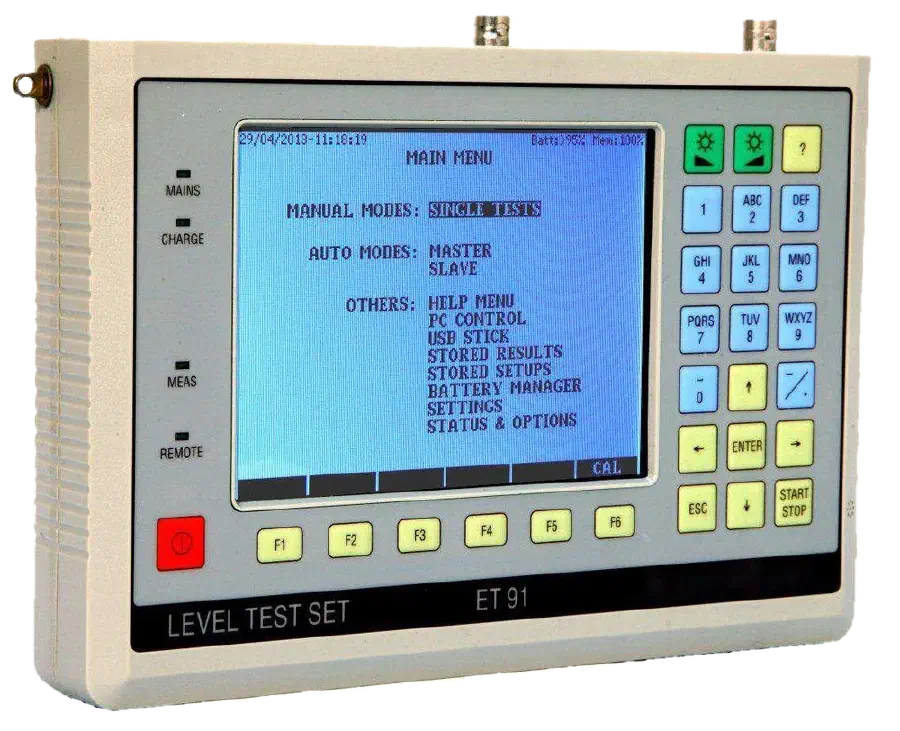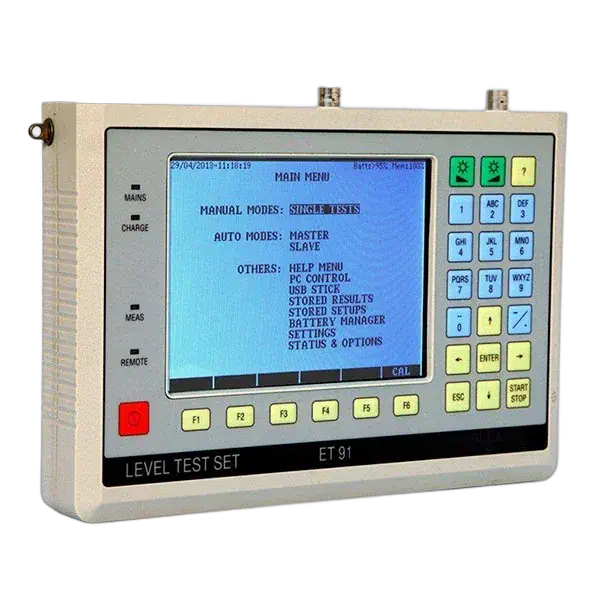
ET91 is a hand-held level test set for testing power line carrier (PLC) systems, FDM systems, audio tone and FSK links, and communication cables. It runs on battery for about 8 hours.
Benefits
Four instruments in one case
Level generator, selective and wideband level meter, measuring bridge and high-resolution spectrum analyzer, all from 100 Hz to 2400 kHz with 1 Hz frequency resolution.
No frequency calculation
The receive frequency is set in carrier ± tone format, exactly as FDM test instructions give it, and in tracking modes the receiver automatically follows the generator.
End-to-end measurements
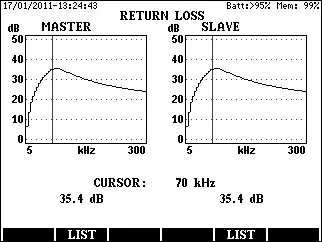
In master-slave mode, two instruments automatically measure the loss, noise, balance, impedance, return loss and crosstalk of a cable, communicating over the line itself.
Results ready for the report
100 setups and 100 results in memory, PASS/FAIL indication, driver-free USB stick transfer and PC software for protocols and printing.
Applications
- Commissioning and maintenance of PLC links and FDM carrier systems.
- Level, psophometric noise, carrier leak, crosstalk and non-linear distortion in voice channels.
- Cable characterization: loss, longitudinal balance (LCL), impedance and return loss.
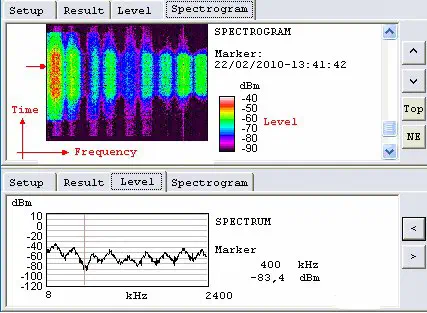
- Interference hunting and power spectral density measurement.
About the product
The selective level meter offers five bandwidths -20 Hz, 200 Hz, 1.74, 1.95 and 3.1 kHz- and measures from -120 to +10 dB; the wideband receiver has six band filters. The built-in bridge measures longitudinal balance under ITU-T O.9, return loss and impedance, and the psophometer complies with ITU-T Rec. O.41. Options: group delay, phase jitter, micro interruptions, spectrogram and external 40 dB attenuators.
Technical specifications
| Frequency range | 100 Hz - 2400 kHz in 1 Hz steps; accuracy 2 ppm ± 1 Hz |
| Generator | +10 to -60 dBm (up to +20 dBm below 10 kHz); single frequency, multi-tone or sweep |
| Selective receiver | -120 to +10 dB; bandwidths of 20 Hz, 200 Hz, 1.74, 1.95 and 3.1 kHz; accuracy ±0.3 dB |
| Impedances | 75, 135 (125), 150 Ω and 600 Ω, or high impedance; balanced and coaxial |
| Measuring bridge | LCL 0 - 70 dB; return loss 0 - 40 dB; impedance 50 - 1600 Ω; NEXT/LOSS up to 80 dB |
| Noise | Psophometric (ITU-T O.41) and 8 band filters; impulse noise from 500 ns; 1 s to 72 h |
| Spectrum analyzer | 300 frequencies; down to -140 dBm/Hz; NORM, PEAK, AVG and SAVG |
| Memory and interfaces | 100 setups and 100 results; USB A (USB stick) and USB B (PC) |
| Power and display | NiMH battery, approx. 8 h; 320 × 240 dot TFT |
| Dimensions and weight | 224 × 160 × 44 mm; approx. 1.5 kg |
Frequently asked questions
Is the receive frequency calculated by hand for FDM systems?
No. Carrier and tone are entered separately, and in tracking mode the receiver tunes by itself to the carrier ± the generator frequency.
Are two instruments needed to test a cable?
For automatic end-to-end measurements, yes: one works as master and the other as slave. Return loss or impedance are measured with a single instrument.
How are results moved to the PC?
With a USB stick, without installing drivers, or by connecting the instrument to the PC through the USB B port and using the PC software.
How long does the battery last?
About 8 hours. It recharges inside the instrument in less than 3 hours with the mains adapter or the 12 V car adapter.