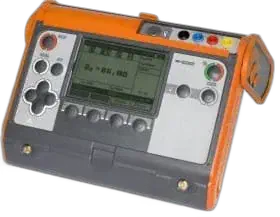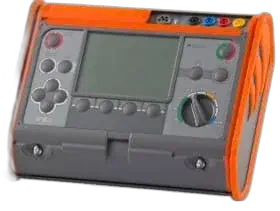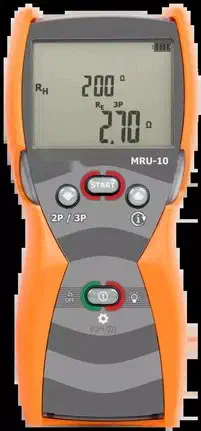
Checking the earthing of an electrical installation, a building or a lightning protection system only needs a compact earth tester that applies the technical three-pole method with auxiliary probes and confirms that the test set-up itself is valid. The AMRU-10 measures earth resistance from 0.53 to 9999 Ω at 50 V per EN 61557-5, with an accuracy of ±(3 % of measured value + 3 digits) up to 199.9 Ω, checks the auxiliary electrode resistances RH and RS up to 19.9 kΩ and keeps measuring with interference voltages of up to 24 V, in a 660 g IP67 housing.
AMRU-10 key data
- Methods: technical 3-pole per EN 61557-5 (standard range 0.53 to 9999 Ω at UN = 50 V) and 2-pole (2p) for quick checks; resolution from 0.01 Ω.
- Accuracy: ±(3 % m.v. + 3 digits) up to 199.9 Ω, ±5 % from 200 to 1999 Ω and ±8 % from 2000 to 9999 Ω, in both methods.
- Test signal: selectable 25 or 50 V and short-circuit current above 20 mA at 125 Hz (50 Hz networks) or 150 Hz (60 Hz networks); each measurement takes less than 8 s with 3 poles and less than 4 s with 2 poles.
- Set-up check: RH and RS from 0 to 19.9 kΩ with ±(5 % + 8 digits), up to 20 kΩ per auxiliary electrode; interference voltage from 0 to 100 V with ±(10 % m.v. + 1 digit).
- Immunity: earth resistance is measured with AC + DC interference voltages of up to 24 V.
- Battery life: 4 AA alkaline batteries or NiMH accumulators for more than 3000 3-pole measurements, with battery status indication and auto-off.
- Construction: IP67 housing per EN 60529, double insulation, CAT III 300 V per EN 61010-1, 221 × 102 × 62 mm and 660 g with batteries; operation from -10 to +50 °C.
Advantages
Two methods, one instrument
The technical three-pole method covers 0.53 to 9999 Ω at 50 V per EN 61557-5, and the two-pole method provides quick checks, both with resolution from 0.01 Ω and accuracy from ±(3 % of reading + 3 digits).
Trustworthy under disturbance
A measurement current above 20 mA at 125 or 150 Hz and a selectable 25 V or 50 V test voltage keep results accurate with disturbance voltages up to 24 V present, and interference voltages are measured up to 100 V.
Auxiliary electrodes verified
The resistances of the auxiliary electrodes RH and RS are measured up to 19.9 kΩ, confirming that the test setup itself is valid before the earth reading is taken.
Made for the field
An ergonomic, rugged IP67 housing, a large backlit segment display and simple, intuitive controls suit outdoor work in most environments.
Simple power, long life
Four AA alkaline batteries or NiMH accumulators with state indication and automatic power-off keep the meter ready; it weighs about 660 g with batteries.
Applications
- Verification of earthing systems in electrical installations.
- Earth electrodes of buildings, substations and lightning protection systems.
- Assessment of earthing quality from the measured result.
- Work by electrical installation contractors and maintenance technicians.
About the product
The AMRU-10 is rated CAT III 300 V with double insulation per EN 61010-1 and IEC 61557 and meets the EMC standards EN 61326-1 and EN 61326-2-2; the set includes 30 m and 15 m test leads on reels, a 2.2 m lead, a crocodile clip, two 25 cm ground probes, AA batteries, carrying case, straps, handle and calibration certificate, with 80 cm probes and leads up to 200 m as options.
Technical specifications
| Measuring methods | Technical 3-pole per EN 61557-5; 2-pole |
| Earth resistance range | 0.53-9999 Ω (UN = 50 V); display from 0.01 Ω |
| Accuracy | ±(3 % m.v. + 3 digits) to 199.9 Ω; ±5 % / ±8 % above |
| Auxiliary electrodes | RH and RS up to 19.9 kΩ; ±(5 % m.v. + 8 digits) |
| Interference voltage | 0-100 V; ±(10 % m.v. + 1 digit); RE valid up to 24 V |
| Measuring current | > 20 mA (short circuit); 125 Hz or 150 Hz |
| Test voltage | Selectable 25 V or 50 V |
| Power supply | 4 × AA alkaline batteries or NiMH accumulators |
| Safety | CAT III 300 V; double insulation; IP67 |
| Operating conditions | -10 to +50 °C; humidity 20-90 % |
| Dimensions and weight | 221 × 102 × 62 mm; approx. 660 g with batteries |
| Measuring time | < 8 s (3-pole); < 4 s (2-pole) |
| Battery life | > 3000 3-pole measurements |
| Standards | EN 61557-5; EN 61010-1; EN 61326-1 and EN 61326-2-2 |
Frequently asked questions
Which simple earth tester is suitable for measuring the earth of a lightning protection system or a building?
One with the three-pole method per EN 61557-5 and a check of the auxiliary probes. The AMRU-10 measures from 0.53 to 9999 Ω at 50 V, with ±(3 % m.v. + 3 digits) up to 199.9 Ω, verifies RH and RS up to 19.9 kΩ and delivers each reading in less than 8 s.
How many measurements does the AMRU-10 make on one set of batteries?
More than 3000 three-pole measurements on four AA alkaline batteries or NiMH accumulators, with battery status indication and auto-off to avoid draining them.
Which measuring methods does it use?
The technical three-pole method (3p) per EN 61557-5 with auxiliary probes, and the two-pole method (2p) for quick resistance checks.
What range does it cover?
From 0.53 Ω to 9999 Ω at 50 V per EN 61557-5, with display resolution starting at 0.01 Ω.
Does it work with interference present?
Yes. It measures reliably with disturbance voltages up to 24 V present and measures interference voltages up to 100 V.
What is the measuring voltage?
Selectable between 25 V and 50 V, with a short-circuit measuring current above 20 mA at 125 or 150 Hz.
Is it suitable for outdoor work?
Yes. The IP67 housing, backlit display, CAT III 300 V rating and roughly 660 g weight make it a true field instrument.