Checking earth electrodes in industrial and building installations without removing the installed rods, and measuring soil resistivity before designing a new earthing system, calls for an earth tester that combines the 3- and 4-wire method with clamp and double-clamp measurement. The AMRU-120 measures earth resistance from 0.30 Ω to 19.9 kΩ per IEC 61557-5 with a test current above 200 mA and an accuracy of ±(2 % m.v. + 2 digits) up to 199.9 Ω, multiple earths with a clamp from 0.44 Ω, with a double clamp up to 149.9 Ω, and soil resistivity by the Wenner method up to 999 kΩm.
AMRU-120 key data
- 3- and 4-wire earth: 0.00 Ω to 19.9 kΩ (from 0.30 Ω per IEC 61557-5), 0.01 Ω resolution, ±(2 % m.v. + 2 digits) up to 199.9 Ω and ±(5 % m.v. + 4 digits) from 2.00 to 19.9 kΩ; 25 or 50 V and current above 200 mA at 125 Hz (50 Hz networks) or 150 Hz (60 Hz networks).
- Multiple earths: 3-wire plus clamp from 0.44 to 1999 Ω per IEC 61557-5 with ±(8 % m.v. + 3 digits); double clamp from 0.00 to 149.9 Ω with ±(10 % m.v. + 3 digits) up to 19.99 Ω and ±(20 % m.v. + 3 digits) above; clamp measurement possible with interference currents of up to 3 A.
- Soil resistivity: Wenner method (ρ = 2πLRE) from 0.0 Ωm to 999 kΩm, with electrode spacing from 1 to 50 m.
- Continuity: protective and equipotential bonding conductors from 0.24 Ω to 19.9 kΩ per IEC 61557-4, with a current of 200 mA or more, ±(2 % m.v. + 2 digits) up to 199.9 Ω and auto-zero of the leads.
- Set-up check: RH and RS up to 19.9 kΩ (20 kΩ maximum per electrode); interference voltage up to 100 V with ±(2 % m.v. + 3 digits), and earth measurement possible with up to 24 V of interference.
- Speed: under 6 s per continuity measurement and under 8 s per earth resistance or resistivity measurement.
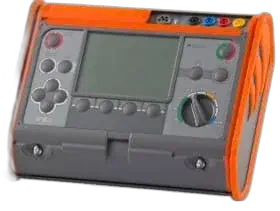
- Instrument: 4.8 V 3 Ah Ni-MH battery (4.2 Ah optional), 990 date- and time-stamped measurements in 10 banks of 99 cells, USB download, IP54, 288 × 223 × 75 mm and about 2 kg.
Measurement methods
- Earth resistance using auxiliary electrodes, by the 3- and 4-wire method.
- Earth resistance using auxiliary electrodes and a clamp, for multiple earth measurements.
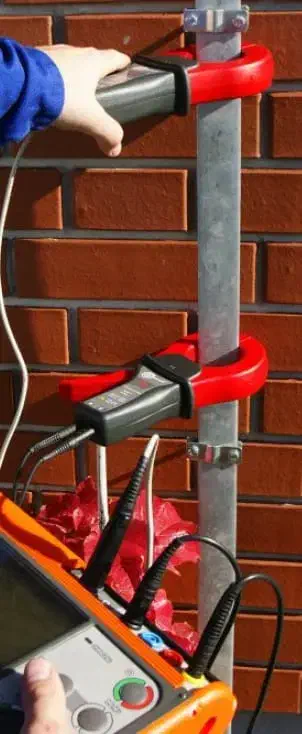
- Earth resistance using two clamps, when auxiliary electrodes cannot be driven into the ground.
- Soil resistivity by the Wenner method.
- Continuity of equipotential bonding and protective conductors, with auto-zero and a 200 mA test current, to IEC 60364-6-61:2000 section 6.12.2.
- Resistance of the auxiliary electrodes RS and RH, and interference voltage with its frequency.
Applications
The meter is intended for checking earth electrodes in electrical, industrial and building installations, where it is useful to measure without disconnecting the earthing system or removing electrodes already in place. The clamp and double-clamp methods verify multiple and interconnected earths without interrupting service, while the soil resistivity measurement supports the design of new earthing installations. The 200 mA test current makes work easier on difficult ground, such as sandy or stony soil.
Power, memory and software
It runs from a rechargeable 4.8 V Ni-MH battery pack (3 Ah as standard, 4.2 Ah optional), giving over 500 measurements per charge and recharged through the supplied Z7 adaptor. It stores up to 990 measurements in 10 banks of 99 cells, each with the real-time clock's time stamp, and transfers them to a computer over the supplied USB cable; an optional OR-1 USB radio interface adds wireless transfer from the meter. Two optional PC applications complete the set: one for creating measurement documentation and one for creating drawings and diagrams of the installations measured.
Technical specifications
| Earth resistance (3- and 4-wire) | 0.00 Ω...19.9 kΩ; to IEC 61557-5, from 0.30 Ω |
| Resistance with clamp (3-wire + clamp) | 0.00...1999 Ω; to IEC 61557-5, from 0.44 Ω |
| Resistance with double clamp | 0.00...149.9 Ω |
| Soil resistivity | 0.00 Ωm...999 kΩm (Wenner method) |
| Protective continuity | 0.00 Ω...19.9 kΩ, current ≥200 mA |
| Measurement category | CAT III 600 V, to EN 61010-1 |
| Protection rating | IP54 |
| Memory | 990 measurements (10 banks of 99 cells) |
| Power supply | 4.8 V Ni-MH battery, 3 Ah (4.2 Ah optional) |
| Warranty | 36 months |
| Accuracy (3- and 4-wire) | ±(2 % m.v. + 2 digits) up to 199.9 Ω; ±(5 % m.v. + 4 digits) from 2.00 to 19.9 kΩ |
| Accuracy with clamp / double clamp | ±(8 % m.v. + 3 digits) / ±(10 % m.v. + 3 digits) up to 19.99 Ω |
| Test current and voltage | > 200 mA; 25 V or 50 V; 125 Hz or 150 Hz |
Frequently asked questions
Which earth tester is best for measuring earths in sandy or stony ground?
One with a high test current that accepts high-resistance auxiliary probes. The AMRU-120 injects more than 200 mA short-circuit current at 25 or 50 V and 125 or 150 Hz, accepts up to 20 kΩ on each auxiliary electrode and measures from 0.30 Ω to 19.9 kΩ per IEC 61557-5 with ±(2 % m.v. + 2 digits) up to 199.9 Ω.
How accurate is the AMRU-120 with a clamp and with a double clamp?
With 3 wires and a clamp, ±(8 % m.v. + 3 digits) from 0.44 to 1999 Ω per IEC 61557-5; with a double clamp, without driving auxiliary electrodes, ±(10 % m.v. + 3 digits) up to 19.99 Ω and ±(20 % m.v. + 3 digits) from 20.0 to 149.9 Ω.
Can it measure earths without disconnecting the system?
Yes. The clamp method and the double-clamp method measure earth resistance without disconnecting the connections or removing auxiliary electrodes.
What test current does it use for continuity?
It uses a 200 mA test current with auto-zero, meeting section 6.12.2 of IEC 60364-6-61:2000.
How are measurements transferred to a computer?
Through the supplied USB cable; the optional OR-1 USB radio interface adds wireless transfer from the meter.
What is the maximum test voltage?
The maximum test voltage is selectable between 25 V and 50 V.
How many measurements does it store?
Up to 990 measurements, organised in 10 banks of 99 cells, each with the date and time from the real-time clock.