An innovative tool that helps users of circuit-breaker test equipment turn their measurements into a diagnosis: Amperis launches High-voltage circuit-breaker diagnostics, a free online tool that assesses the tests of a circuit-breaker to IEC 62271 or ANSI / IEEE C37 and returns the verdict, the likely cause of each finding and an action plan.
A circuit-breaker analyser delivers opening and closing times, travel curves, coil currents and contact resistances in a few minutes. The hard part comes next: deciding whether those values are within tolerance, what they indicate when they are not and what to do with the circuit-breaker. That interpretation depends on the applicable standard, the manufacturer's data and the engineer's experience, and it is exactly what the new tool puts within reach of every user.
Try it now: open High-voltage circuit-breaker diagnostics. It runs in the browser, with nothing to install, in six languages.
From test to diagnosis in a single step
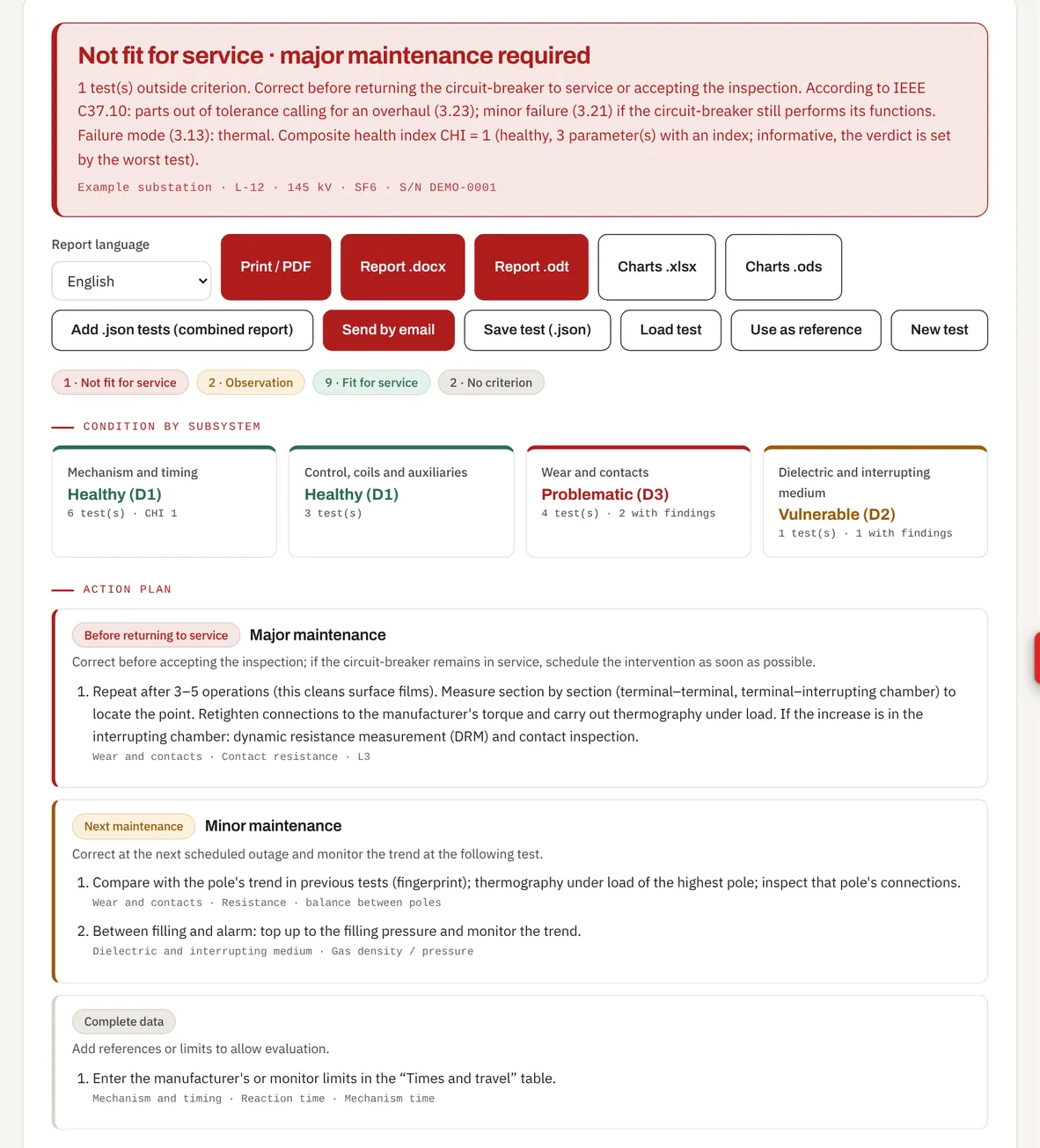
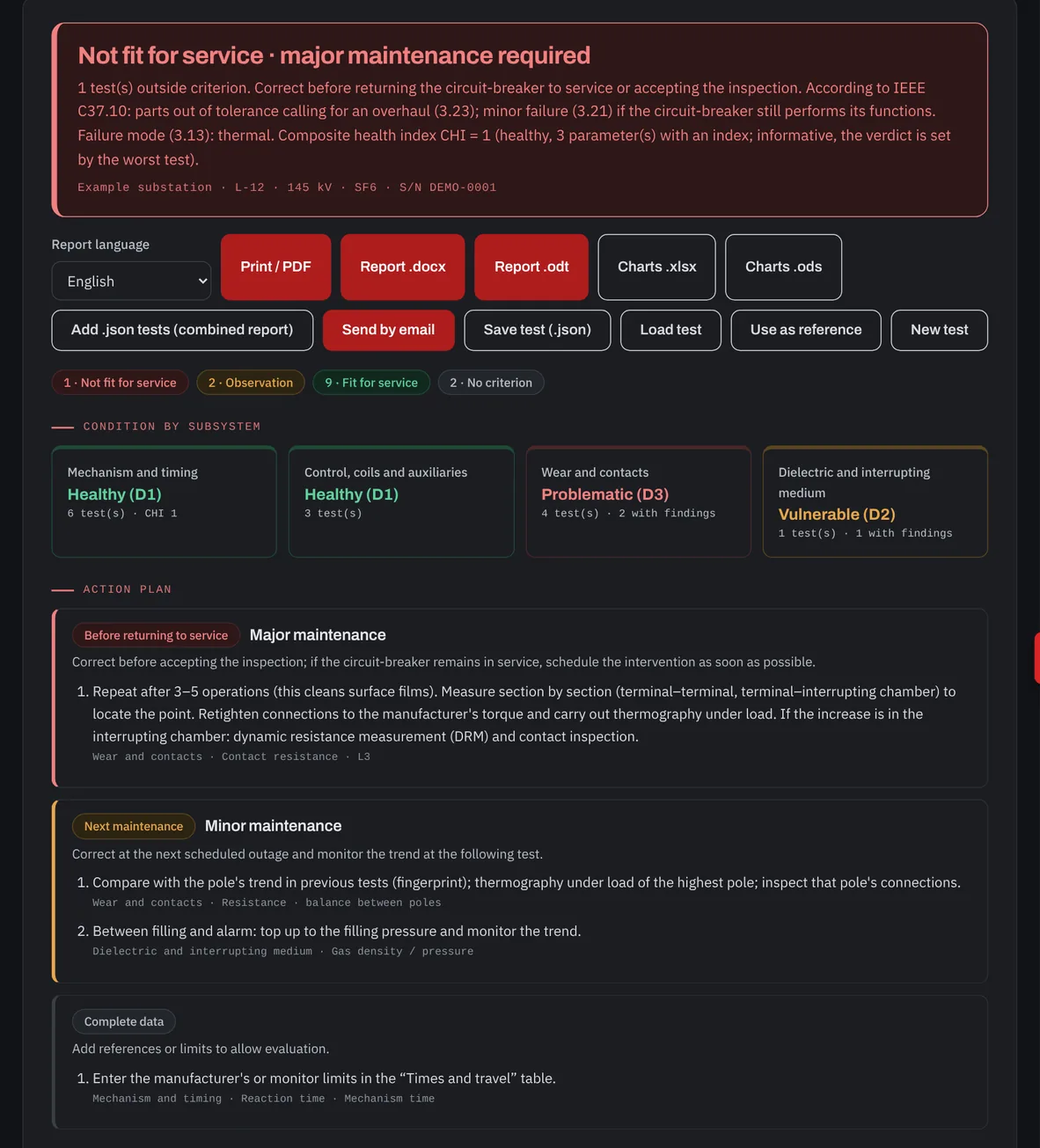
The engineer enters the nameplate data and whatever measurements are available —not all of them are needed— and the tool assesses each test separately against its criterion. The result is organised as a maintenance engineer would organise it:
- Verdict: pass, pass with remarks, fail or critical, aligned with the deterioration bands in the technical literature (healthy, vulnerable, problematic and failure).
- Status per subsystem: mechanism and timing; control, coils and auxiliaries; wear and contacts; dielectric and interrupting medium.
- Likely cause and action for each finding, with the standard or source that sets the limit.
- Action plan grouped by priority: immediate, before returning to service or at the next maintenance.
- Health index per parameter and composite (CHI), using the method of Dehghanian, Popovic and Kezunovic.
Your curves, read and interpreted
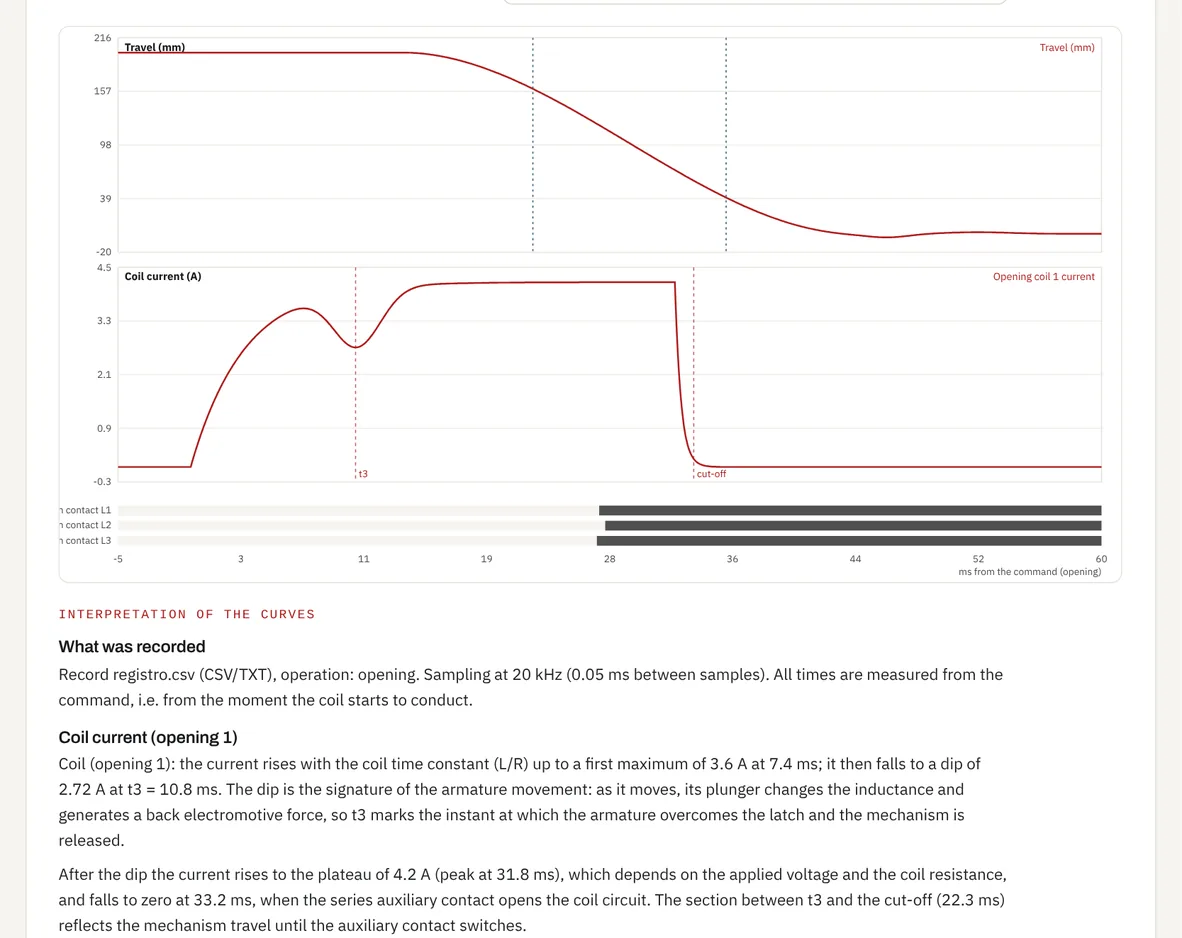
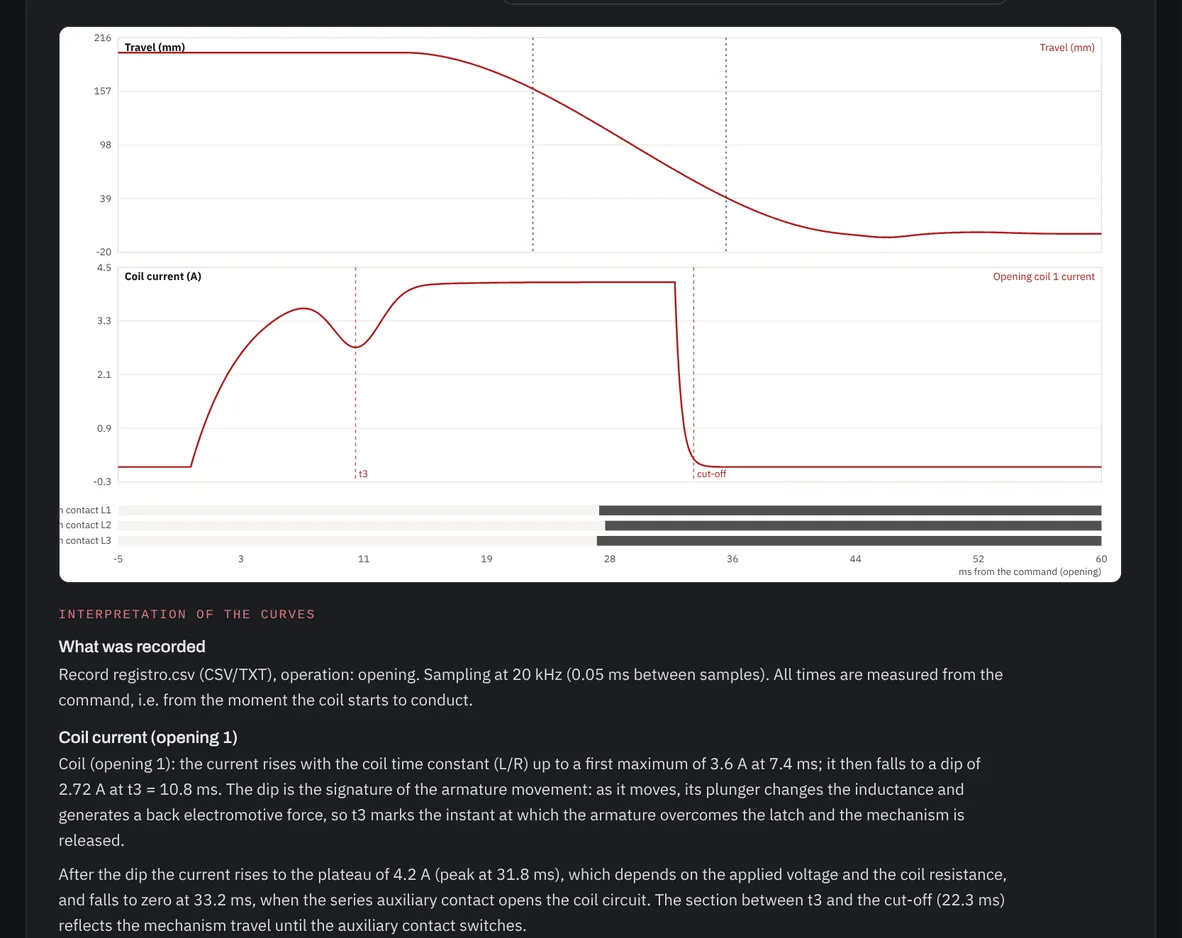
The tool imports analyser records directly: COMTRADE (.cfg/.dat or .cff), CSV or TXT, and Excel (.xlsx and .xls) or LibreOffice Calc (.ods) spreadsheets. It detects the format and the use of each channel and extracts the times per pole, stroke, speed, overtravel and rebound, the coil signature (peak, t3 dip and cut-off), the control voltage during the operation and O–C, C–O and O–C–O sequences, including dynamic resistance (DRM).
It also writes an interpretation of the curves in technical language: what was recorded, what each section of the coil current means, what the travel says about the damper or the linkage and, if there is a signature from an earlier test, what has changed and why it may have changed.
IEC 62271 or ANSI / IEEE C37 criteria, your choice
Each circuit-breaker is assessed under the framework that applies to the installation: the IEC 62271 series (62271-1, -100, -110 and -203) or ANSI / IEEE C37 (IEEE C37.04 and C37.10, ANSI C37.16 and C37.32). The tests assessed include timing and simultaneity between poles and between breaks, main circuit resistance, minimum operating voltage of the releases, coil signature, SF6 density and leakage trend, accumulated electrical wear, pre-insertion resistance, grading capacitors and thermography. Where the standard refers to the manufacturer, the tool uses its reference and tolerance or, failing that, the circuit-breaker's own signature.
Reports, history and trends
The diagnosis can be printed or downloaded as PDF, Word (.docx) or ODT, in the language of the page or in any of twenty-two languages, and the curves can be exported to Excel and Calc with their charts. With a free account, protected by two-step verification, successive tests of each circuit-breaker are saved to a history that calculates the trend of each parameter and the estimated time until it reaches its limits; several tests of the same unit produce a combined report. The report can also be emailed straight from the tool.
Also for your systems and AI agents
The same diagnostic engine is available as a REST API and MCP server, to integrate it into a maintenance management system or into AI assistants such as Claude or Cursor. The API manual explains the calls, the fields and how to connect the MCP server.
How to get started
- Open the tool under Resources › Tools › High-voltage circuit-breaker diagnostics.
- Enter the equipment data and choose the framework: IEC 62271 or ANSI / IEEE C37.
- Import your analyser record or type the measurements into the resistance, timing, coils, gas and inspection tabs.
- Click “Diagnosis” and download the report or send it by email.
The result is indicative and generated automatically from the data provided: the circuit-breaker manufacturer's values and instructions always take precedence, and the decision to return it to service lies with the responsible engineer.
Equipment and contact
The Amperis technical department can advise you on choosing circuit-breaker test equipment and on interpreting your tests.
- High-voltage circuit-breaker diagnostics · SF6 calculator
- Circuit-breaker analysers: CAT Advanced Series
- Micro-ohmmeters: RMO-A · Coil analysers
- SF6: gas analysers and leak detectors · full circuit-breaker testing range
- Related articles: AC and DC circuit-breaker testing with the SA10A · measuring contact resistances · six webinars on circuit-breakers and switchgear
Image credits
- Screens of the tool, with an example circuit-breaker: Amperis Products S.L.
Standards are cited by name; this article does not reproduce their text, which must be consulted in the official edition. High-voltage circuit-breaker diagnostics is an indicative tool: the software may contain errors and the tests must be checked with the circuit-breaker manufacturer.