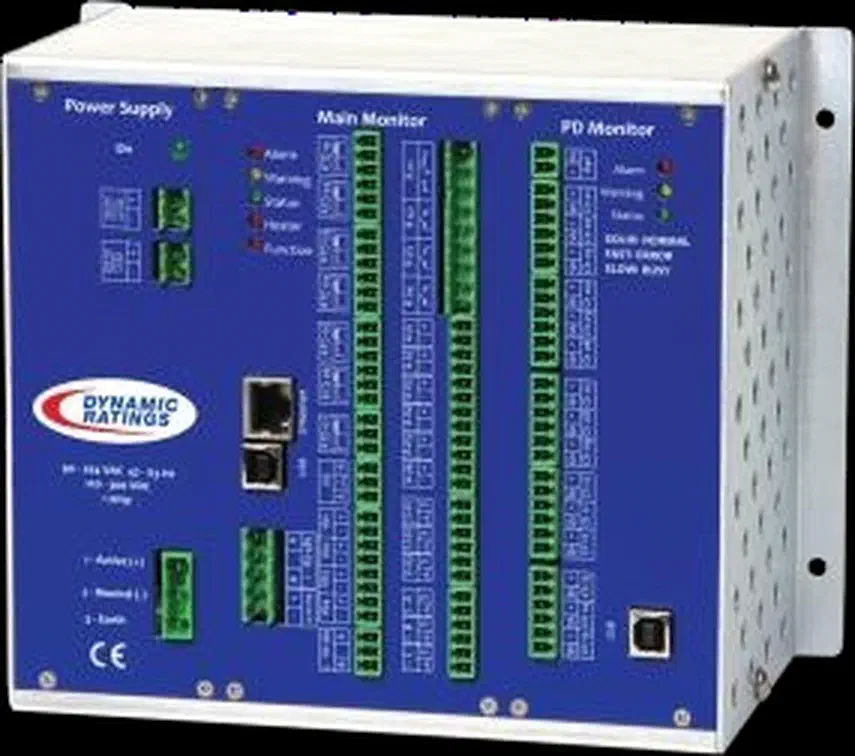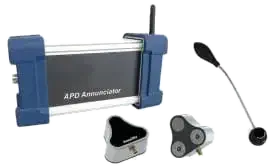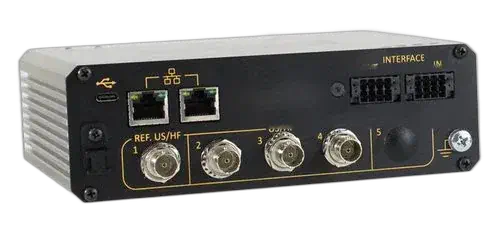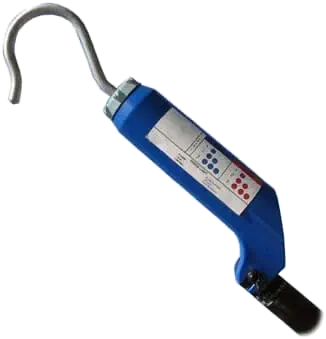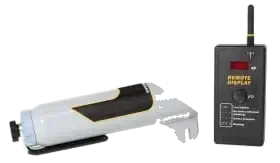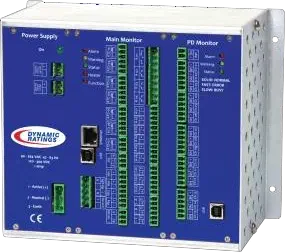
The Dynamic Ratings RMM watches the partial discharge activity of the stator winding insulation in medium and high voltage motors and generators, without taking the machine out of service. It records and correlates the operating dynamics at the same time, so every discharge reading can be read against the load, the voltage and the winding temperature of that moment. It also works on machines fed from variable frequency drives.
Advantages
Trend instead of snapshot
Periodic measurement shows the condition of the insulation on the day of the test. Continuous monitoring shows how it evolves, which is what makes it possible to plan an intervention before the fault appears. The unit stores up to two years of data on a first-in, first-out basis.
Discharge and operating dynamics together
Inputs are available for six winding temperatures, three load currents, three voltages and six user-defined 4-20 mA signals, so the discharge activity can be correlated with what the machine was doing.
Standalone operation
The monitor runs on its own, with no computer attached, and still reports through its built-in interfaces, so it can be left permanently installed in a plant that has no dedicated maintenance network.
Applications
- Turbogenerators and hydrogenerators in power plants.
- Large medium and high voltage motors driving critical processes.
- Machines fed from variable frequency drives.
- Detection of broken rotor bars in induction machines through current signature analysis.
- Installations in hazardous areas, with the explosion-proof enclosure version.
Detection across the whole winding
Coupling capacitors pick up the discharge activity near the machine terminals. The RTD-PD module reaches the discharge produced deep inside the winding, where the temperature detectors already respond to its high-frequency content. Used together, both techniques widen the detection area, and four measurement parameters are recommended for any machine: magnitude, pulse count, discharge intensity and phase distribution. Existing sensors can be reused where the machine already has coupling capacitors fitted, which shortens the commissioning work and keeps the outage to a minimum.
Results and software
Results are presented in every format used in the industry: two-dimensional and three-dimensional phase-resolved patterns, the polar view over the phase circle, the pulse height distribution and the trend of each quantity over time, with several channels compared on the same screen. The dashboard software configures the instrument, downloads and stores the data and provides the analysis tools.
Specifications and mounting
- 15 partial discharge channels per module, acquired simultaneously.
- 70 dB dynamic range, from 3 mV to 10 V, with no gain adjustment.
- Measuring bandwidth from 1 MHz to 20 MHz and phase resolution of 7.5°.
- Ethernet, USB and RS-485 interfaces, with ModBus as standard and DNP-3 on request.
- Supply from 90 to 264 V AC at (47-63) Hz, or from 100 to 300 V DC.
- Standalone, panel, enclosure or hazardous area mounting, the latter in 316 stainless steel.
The Dynamic Ratings RMM is manufactured by Dynamic Ratings and distributed by Amperis.