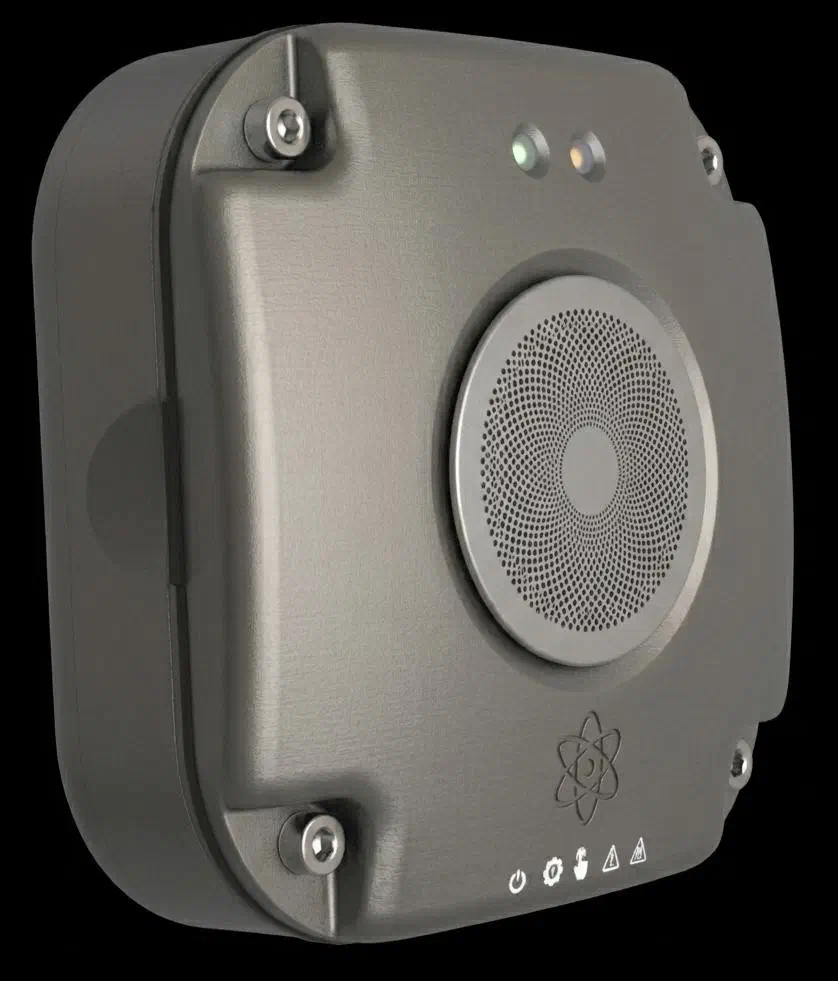
The hydrogen area monitor detects H2 in stationary battery installations with a sensor engineered for battery-room environments, with continuous self-calibration and no maintenance over a 10-year-plus service life.
Advantages
Hydrogen safety without maintenance
A hydrogen-specific sensor with continuous internal self-testing verifies its own health and accuracy over its whole life, with no manual calibration and no board replacements.
No false alarms
The sensor has no cross sensitivity to other gases, eliminating the drift, false triggers and premature failures typical of catalytic-bead and metal-oxide sensors.
Compliance built in
It keeps installations aligned with global fire and safety standards — IFC, NFPA 1, NFPA 2, NFPA 855, OSHA 1910, IEC 62485-2, IEC 62933-5-2 and IEEE 484 & 1635.
Measured and reliable
It measures H2 from 0.4 to 5 % with ±0.3 % accuracy and a 50-70 second response, providing 1 % and 2 % concentration alarms and a fault indicator.
Flexible integration
Modbus RTU (RS-485), 4-20 mA analog output and dry relay contacts, with wall, DIN-rail, junction-box and magnetic mounting and AC/DC power with automatic switchover.
Applications
- Standby-power and emergency battery rooms.
- Lead-acid and NiCad battery installations and cabinets.
- Telecommunications backup and data-centre standby power.
- Electrical substations, switchgear and SCADA systems.
- Hydrogen generation, forklift charging and fuel-cell applications.
About the product
The monitor runs on 85-264 V AC and 15-60 V DC with automatic switchover and a service life above 10 years; four models cover the communication needs of each installation — 8111 (Modbus RTU, 4-20 mA, dry contacts and fault indicator), 8110 (4-20 mA and dry contacts), 8101 (Modbus RTU and dry contacts) and 8100 (dry contacts with 1 % and 2 % alarms).
Technical specifications
| Detection range | 0.4-5 % H2; lower detection limit 0.4 % |
| Accuracy | ±0.3 % H2 (±1 % above 2 %) |
| Response time | 50 to 70 seconds |
| Alarms | 1 % and 2 % H2 concentration; fault indicator |
| Communication | Modbus RTU (RS-485); 4-20 mA analog; dry relay contacts |
| Power | 85-264 V AC; 15-60 V DC; automatic AC/DC switchover; 10 W max |
| Mounting | Wall, DIN-rail, junction box and magnetic |
| Service life | Above 10 years; maintenance-free, no calibration |
| Environment | 15 to 40 °C; 0-95 % RH non-condensing |
| Dimensions and weight | 132.5 × 130.5 × 52.9 mm; 0.5 kg |
| Models | 8111, 8110, 8101 and 8100 (communication variants) |
Frequently asked questions
What does it detect?
Hydrogen (H2) from 0.4 to 5 % by volume, with a lower detection limit of 0.4 % and ±0.3 % accuracy.
Does it need calibration?
No. It is maintenance-free, with continuous automated self-calibration and no board replacements over a 10-year-plus service life.
Which standards does it help meet?
IFC, NFPA 1, NFPA 2, NFPA 855, OSHA 1910, IEC 62485-2, IEC 62933-5-2 and IEEE 484 & 1635, among others.
How does it communicate?
Through Modbus RTU (RS-485), a 4-20 mA analog output and dry potential-free relay contacts, with 1 % and 2 % alarms.
How is it mounted and powered?
Wall, DIN-rail, junction-box or magnetic mounting, with 85-264 V AC and 15-60 V DC power and automatic switchover.