Data centres, substations, electric vehicles and energy storage systems all rely on batteries that give no warning when they lose capacity. Knowing how much life they have left —their battery life forecast— starts with measuring their state of health (SOH). We look at why it matters, which criteria IEEE and IEC standards set for each chemistry and how to obtain the estimated remaining life with the Amperis online tool.
In an era when artificial intelligence demands data centres with uninterrupted availability, electric vehicles are transforming urban mobility and battery energy storage systems (BESS) offset the intermittency of renewables, the power grid depends on a component as crucial as it is silent: the battery. In critical infrastructure —from high-voltage substations to cloud computing centres— a battery rarely fails unexpectedly: it fails through neglected degradation.
That is why the battery life forecast is no longer just another technical indicator but the foundation of operational resilience. It is based on the state of health, usually abbreviated to SOH, which shows how much of its original capacity a battery retains and, therefore, whether it will still deliver the backup time it was designed for on the day it is needed, and for how much longer it can do so.
Why is state of health the definitive metric?
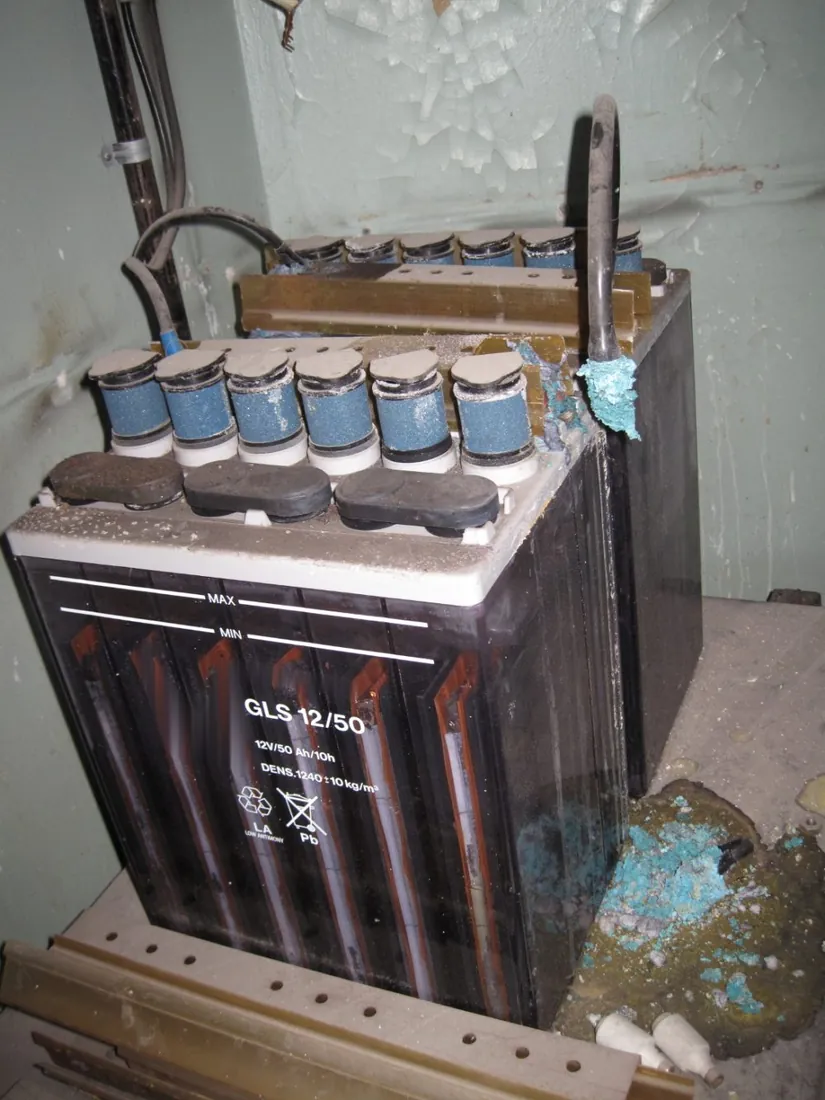
Unlike the state of charge (SOC), which reflects how much energy is available at a given moment, the state of health measures the battery's maximum usable capacity and the increase in its internal resistance compared with its as-new condition. Over time, cycling, temperature and the chemistry itself wear it down: in lead-acid, sulphation, grid corrosion and electrolyte loss; in lithium, loss of active lithium, growth of the passivation layer (SEI) and metallic lithium plating (dendrites). The result is always the same: less energy delivered when it is needed.
| Quantity | What it indicates | When it changes | How it is measured |
|---|---|---|---|
| SOC · state of charge | Energy available now, as % of current capacity | With every charge and discharge | Open-circuit voltage, BMS Ah counting or electrolyte specific gravity |
| SOH · state of health | Capacity the battery retains, as % of rated capacity | Slowly, as it ages | Capacity discharge test; internal resistance as an indicator |
The consequence is stark: a battery at 100 % charge but with a state of health of 60 % delivers only 60 % of the backup it was designed for. In a data centre carrying AI loads of hundreds of megawatts, or in a substation that must trip its protection on a short circuit, relying on a degraded battery is like operating without a safety net.
How state of health is determined: capacity first, resistance as a warning
The primary state of health is the capacity-based SOH (SOH-C): the battery's actual capacity, obtained from a controlled discharge test at constant current or constant power down to the end voltage, corrected to the reference temperature and compared with the manufacturer's rated capacity at the same rate. It is the replacement criterion in every maintenance standard and the only one that proves the real backup time.
The resistance-based state of health (SOH-R) is an indirect indicator: the internal resistance, impedance or conductance of each cell, compared with its commissioning value or the manufacturer's value. It does not replace the capacity test, but it detects weak cells and trends without discharging the battery. In lead-acid, a 20 % increase over the baseline is already a warning sign (IEEE 1188), and 50 % is a replacement criterion according to Best Practices.
| Chemistry | End of life (EOL) | What happens when it is reached | Reference standard |
|---|---|---|---|
| Vented lead-acid (VLA) | < 80 % of rated | Replacement, within one year at most | IEEE 450 |
| VRLA lead-acid (AGM and GEL) | < 80 % of rated | Replacement | IEEE 1188 · IEC 60896-21/-22 |
| Nickel-cadmium | < 80 % of rated | Recondition and retest; if it does not recover, replacement | IEEE 1106 · IEC 60623 |
| Stationary lithium-ion | < 80 % in backup · < 70 % in BESS | Planned retirement; consider second life | IEEE 2962 · IEC TS 62933-3-1 |
| Electric vehicle lithium-ion | < 70 % (typical) · 60 % in second life | End of traction life; possible stationary use | JRC report EUR 29371 |
All capacity values refer to a reference temperature, normally 25 °C, because a cold battery delivers less. Best Practices applies a linear correction with a coefficient of 0.006 per °C for lead-acid and 0.002 per °C for nickel-cadmium; IEEE 450 provides its own tables for vented lead-acid, and IEEE 2962 those for lithium.
The regulatory framework: which standards require it
To ensure reliability at scale, the industry follows international standards that define how batteries are monitored, assessed and retired. These are the main ones. Those marked criterion are the ones the Amperis tool uses to reach its verdict; those marked reference complete the framework in terms of safety, installation and mobility.
| Standard | Scope | What it contributes to the diagnosis | Use |
|---|---|---|---|
| IEEE 450 | Stationary vented lead-acid | Inspections, capacity tests, temperature correction and replacement at 80 % | criterion |
| IEEE 1188 | Stationary VRLA lead-acid | Inspections, quarterly ohmic measurement, capacity tests and replacement at 80 % | criterion |
| IEC 60896-21 IEC 60896-22 | Stationary VRLA lead-acid | Test methods and requirements: capacity, internal resistance, recharge and thermal runaway | criterion |
| IEC 61056-1 | General-purpose VRLA (UPS, emergency systems, portable equipment) | Charging and test conditions, and reference capacity | criterion |
| IEEE 1106 IEC 60623 | Nickel-cadmium | Maintenance, capacity testing and reconditioning | criterion |
| IEC 61951-2 | Portable nickel-metal hydride | Reference capacity and internal resistance method | criterion |
| IEEE 2962 | Stationary lithium-ion | State of health (SOH) assessment, temperature correction and end of life | criterion |
| IEC 61960 | Portable lithium cells and batteries | AC and DC internal resistance method | criterion |
| IEC TS 62933-3-1 | Battery energy storage systems (BESS) | System energy, efficiency and end of life | criterion |
| IEC 62619 IEC 62620 | Lithium in industrial and BESS applications | Safety (62619) and performance (62620) requirements for cells and batteries | reference |
| IEEE 1187 IEEE 1491 | Stationary installations (substations, industrial UPS) | Design and installation of VRLA batteries (1187) and selection of monitoring equipment (1491) | reference |
| ISO 12405 UL 2580 | Electric vehicle | Testing of lithium traction packs (ISO 12405) and their safety (UL 2580); state of health determines range and residual value | reference |
On this basis, the tool applies the Best Practices criteria by default: a compilation, prepared by Amperis, of the recommendations of the international standards and of the most widely accepted battery manufacturers in the sector. It brings together in a single framework the end-of-life limits for capacity and resistance, voltage and specific gravity tolerances, temperature correction and minimum insulation. Where Best Practices and a specific standard differ, the tool applies Best Practices and reports the alternative given by the standard.
One chemistry, one criterion
Each technology ages differently and has its own standard. That is why a single threshold is not enough: float voltage, cell-to-cell tolerance, temperature correction and end of life change from one chemistry to another.
Lead-acid: vented (VLA) and valve-regulated (VRLA)
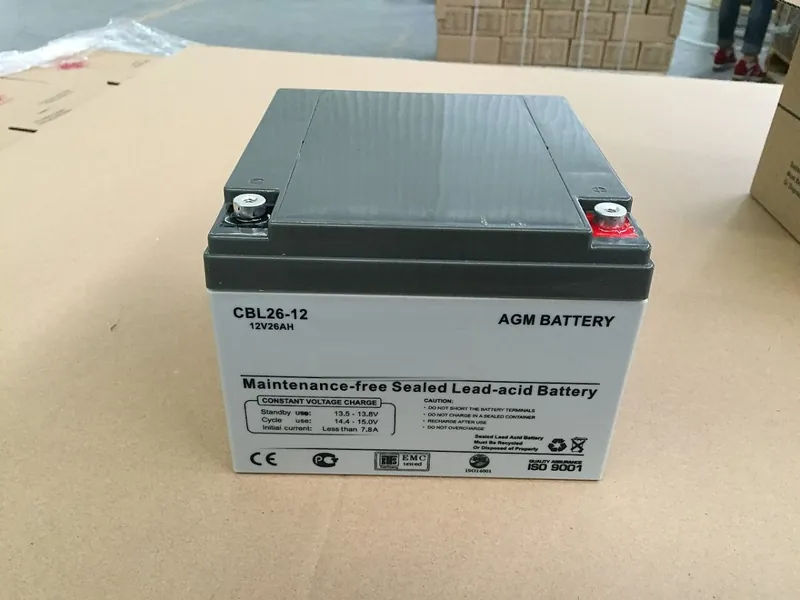
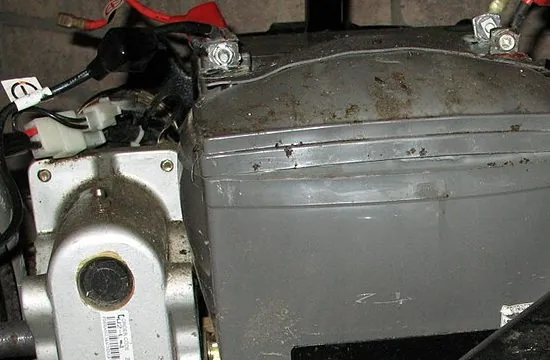
This is the most widespread technology in backup applications: substations, telecommunications and UPS. In vented batteries the electrolyte specific gravity is also measured and water is topped up; VRLA batteries (AGM and GEL) need no electrolyte maintenance, but they are very sensitive to temperature and overvoltage. IEEE 1188 calls for measuring their internal resistance every quarter, and IEC 60896-21 includes a thermal runaway test: excessive float voltage or an overheated room can trigger it. A bulging VRLA is grounds for immediate replacement.
Nickel: industrial nickel-cadmium and nickel-metal hydride
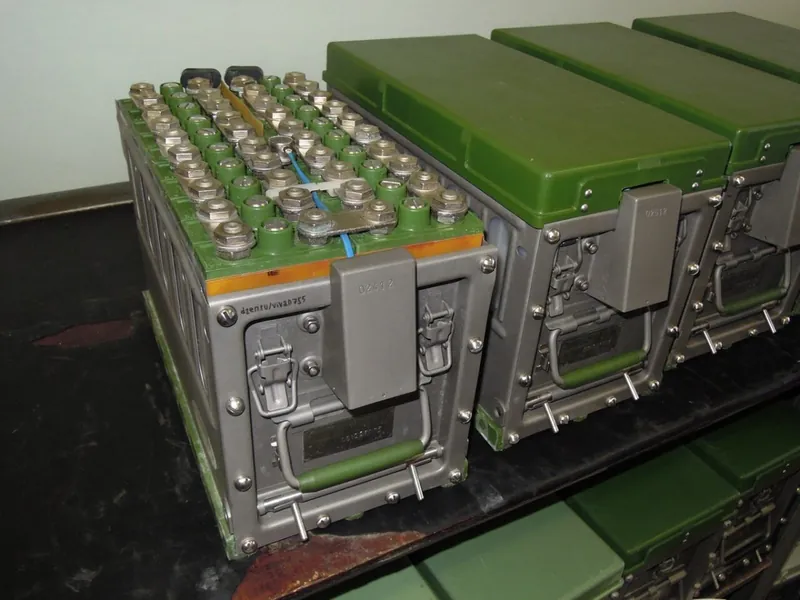
Nickel-cadmium is common in substations, railways and industry thanks to its robustness against cold and cycling. When its capacity falls below 80 %, the answer is not immediate replacement but reconditioning: full discharge, constant-current charge and a new test. Nickel-metal hydride is used in portable equipment; IEC 61951-2 sets its test conditions, at 20 ± 5 °C and without temperature correction.
For stationary vented nickel-cadmium, IEEE 1106 adds its own warning signs: a cell on float below about 1.35 V calls for a boost charge, an average of 1.30 V or less means the battery is discharging, and a capacity loss of more than 1.5 % a year means it must be tested every year instead of every five.
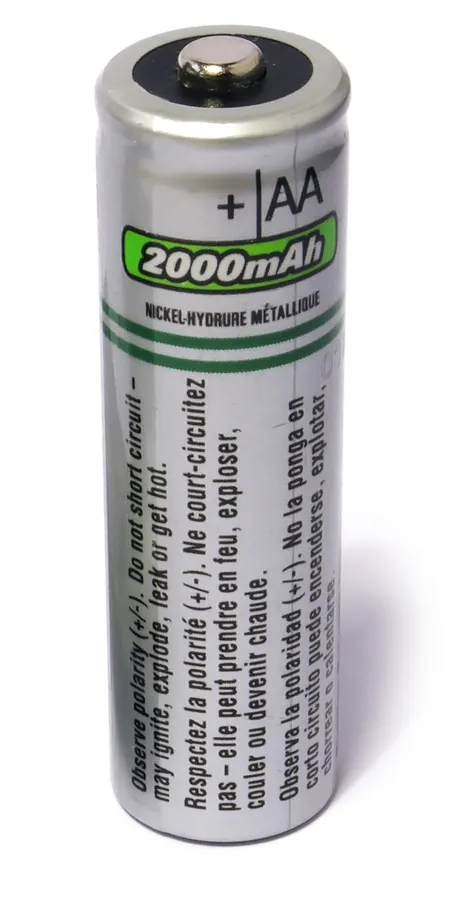
Lithium and sodium: end of life depends on the application
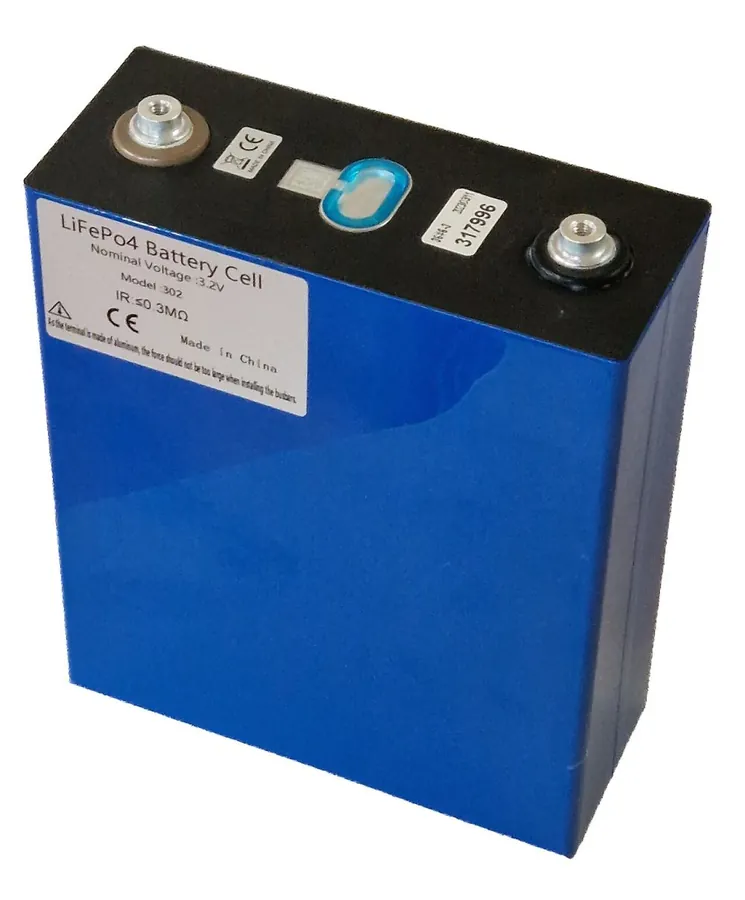
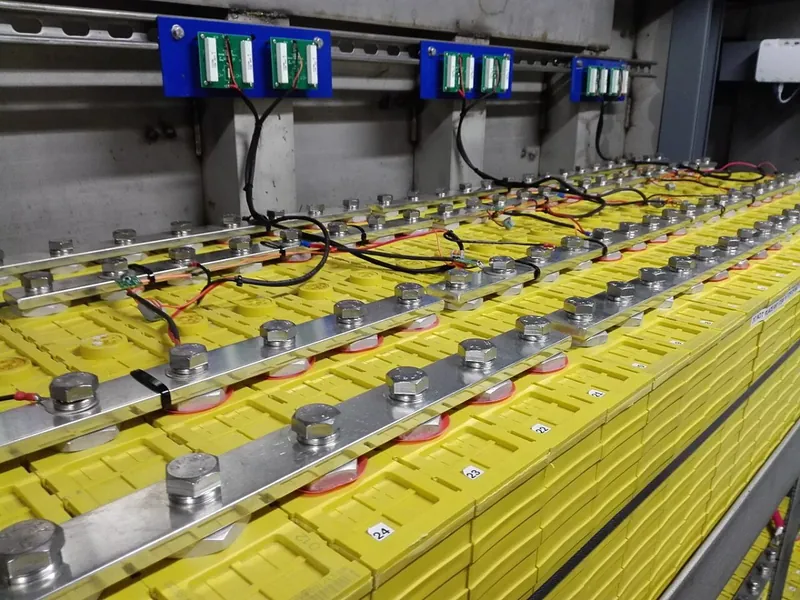
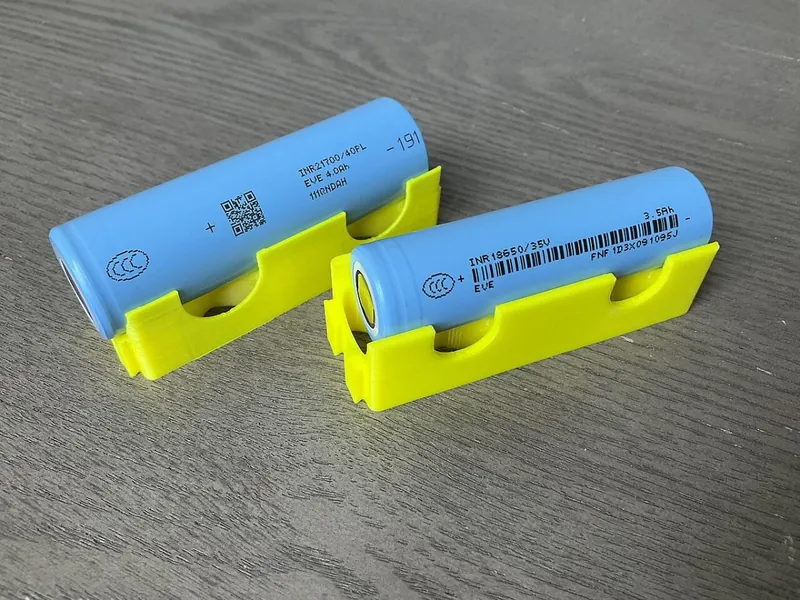
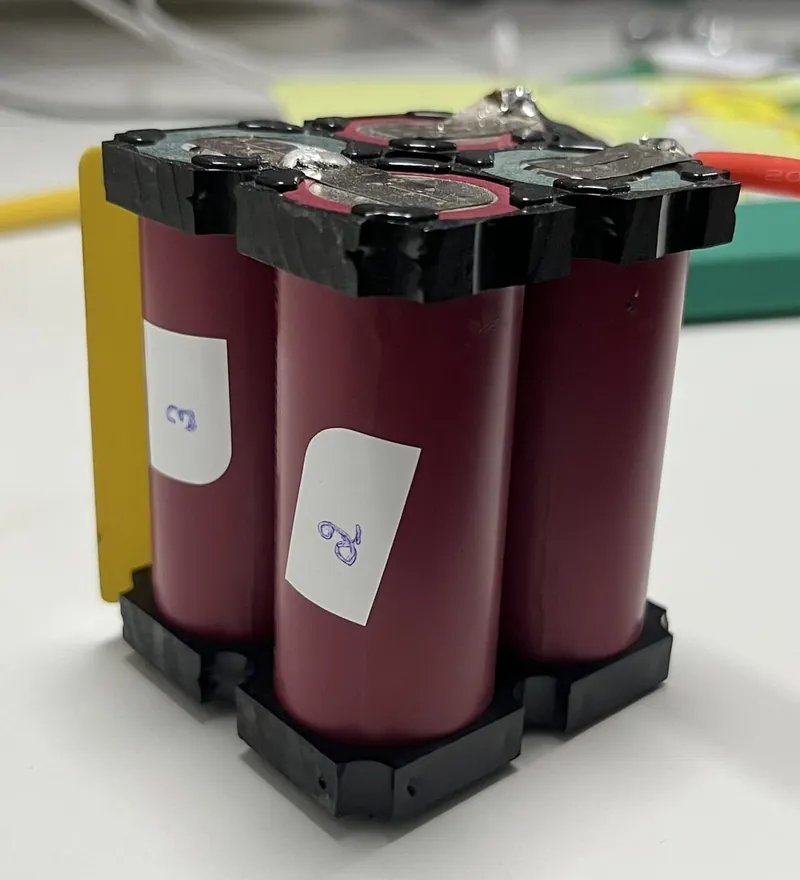
In lithium, end of life is not a single number: a backup battery is retired at 80 %, a BESS or an electric vehicle usually at 70 %, and a second-life battery can operate down to 60 %. IEEE 2962 defines how to test them —with the battery practically full at the start— and how to correct for temperature. The SOH calculated by the BMS must be checked against periodic tests, and a difference of more than 30 mV between cells calls for balancing. Unlike lead-acid, capacity loss in lithium is irreversible: it cannot be regenerated. Sodium-ion, the emerging technology, follows similar criteria that are still under development.
From health to forecast: how much life is left
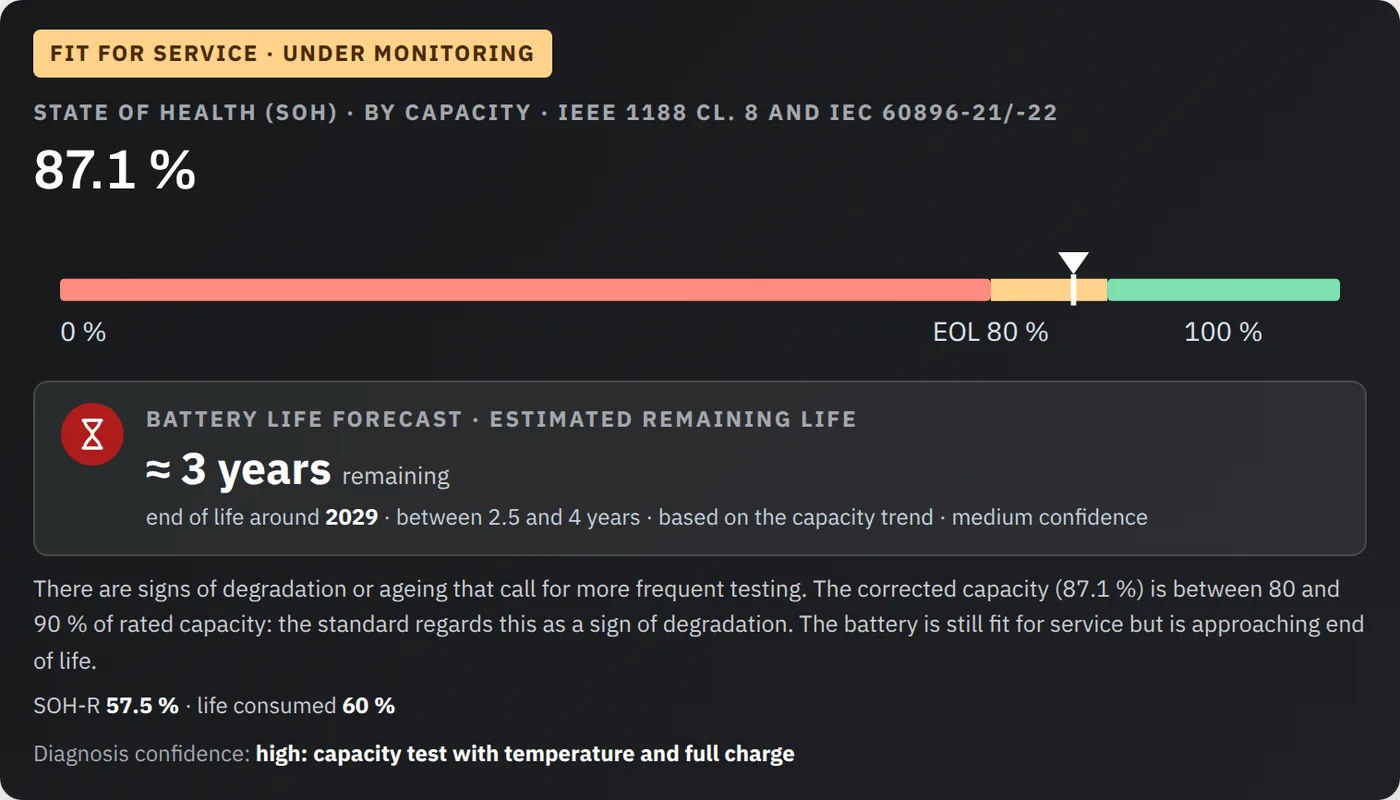
The state of health tells you how the battery is today; the battery life forecast answers the question that really matters for planning: how much time does it have left? To estimate it, three sources are combined and the least favourable is taken:
- The capacity trend. The capacity loss per year —between two tests or since commissioning— is projected to the end of life for the chemistry. It is the most reliable estimate when test data are available.
- The calendar. The manufacturer's design life, corrected for the average operating temperature, minus the age of the battery. In lead-acid, a room at 33 °C halves the expected life.
- The cycles. In cyclic service, the rated cycle life remaining at the current rate of use.
The result is an estimated remaining life, with the expected end-of-life year, a range and a confidence level. It is an indicative extrapolation: in lead-acid, capacity falls faster as it approaches end of life, so the test should be repeated according to the schedule in the standard and the forecast updated.
Good practice for effective monitoring
Manufacturers of batteries and battery management systems (BMS) agree that modern monitoring must go beyond measuring voltage. These are the practices that make the difference:
- Regular tracking of internal resistance. Its increase is one of the most reliable indicators of chemical degradation and gives warning before capacity loss becomes critical. It is only comparable when measured with the same type of instrument and against a baseline from the battery itself.
- Smart BMS and cloud models (digital twins). Combining real-time measured data with algorithms that emulate the degradation of each chemistry —LFP, NMC, sodium or solid-state— makes it possible to anticipate how the state of health will evolve depending on temperature and usage profile. Even so, the BMS SOH must be checked against tests.
- Capacity tests with controlled discharge. However far continuous analysis advances, periodic discharges under standardised parameters remain the reference for validating the real state of health: with the battery fully charged, recording the initial temperature and the voltage of each cell.
- Rigorous thermal control. Temperature is the leading cause of ageing. In lead-acid, every 8 °C above 25 °C halves battery life: keeping the room between 20 and 25 °C can double the service life of the bank compared with a room at 33 °C.
- Baseline and trend. Record the commissioning values and compare each test with the previous one. A loss of more than 10 points between tests is a reason for closer observation, according to IEEE 450 and IEEE 1188.
Try the Amperis Battery life forecast
To help you take the first step, Amperis has developed an online tool that applies all these criteria to your battery data. It runs in the browser, on desktop and mobile, and only assesses what you have measured: missing data are not penalised but appear as a pending test, together with the standard that requires it.
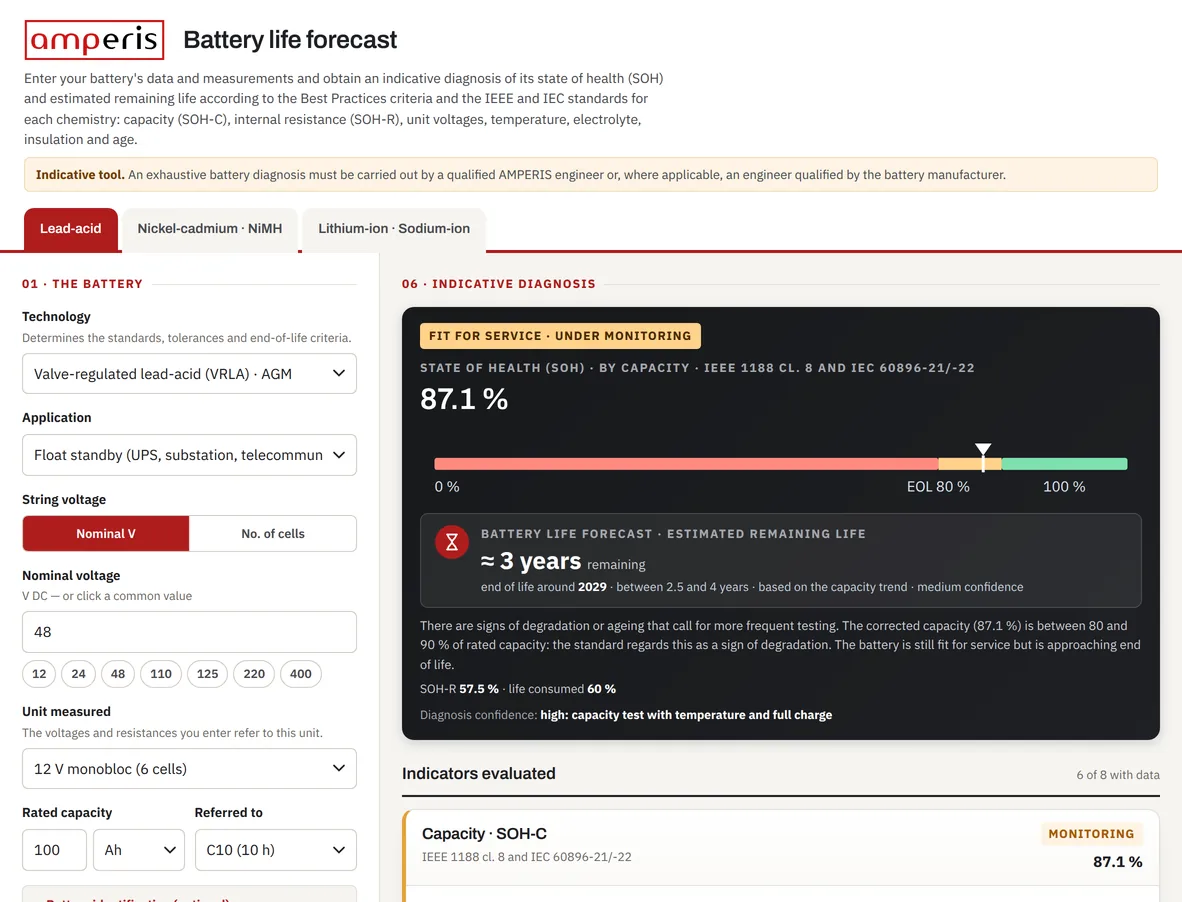
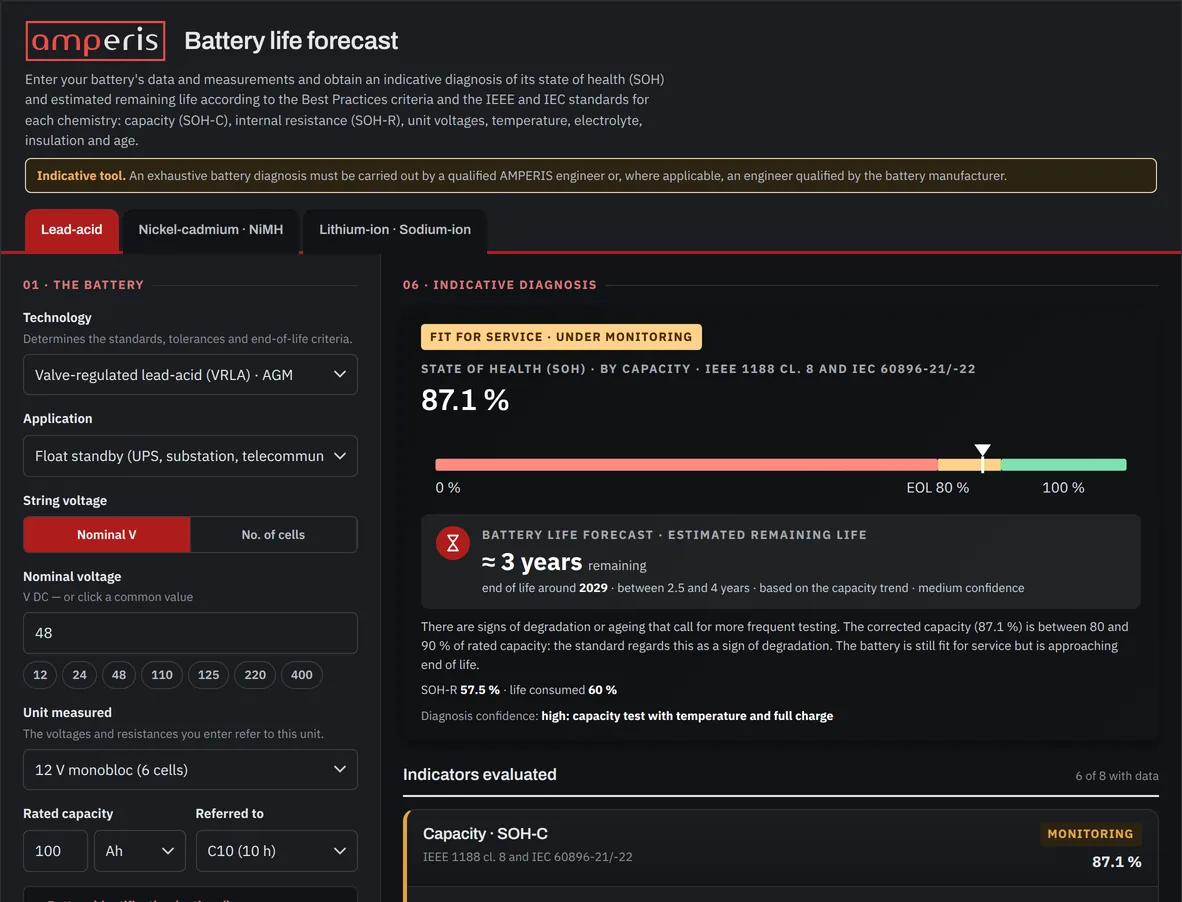
- Choose the chemistry in its tab —lead-acid, nickel, or lithium and sodium— and the application: the standards, tolerances and end of life change accordingly.
- Import your instrument's report or enter the data you have: the capacity test, internal resistances, cell voltages, temperatures, electrolyte, age and the findings of the inspection.
- Click “Diagnose”. You will get the verdict, the state of health and the estimated remaining life, with its confidence level, one card per indicator with the applicable standard, actions ranked by urgency and the reference test plan.
- Print the report or request a review by an Amperis engineer with the diagnosis attached.
If you already have the report from your capacity analyser, cell monitor or ohmic tester, there is no need to type anything. The tool imports PDF, Excel (xls and xlsx), LibreOffice (ods), CSV and TXT files from any instrument or logging system. It recognises the discharge test, the curve, the voltage of each cell (flagging the weakest) and the resistance of each unit, and lets you choose what to transfer to the form. For large strings, quick entry is enough: the average value, the number of units and only the ones that are out of range. And if your battery manufacturer's datasheet sets its own alert threshold, you can apply it instead of the Best Practices one.
Cell voltages are organised as in a maintenance protocol: one tab for float voltages, before the test, and two more for readings during the discharge, at 50 % and 90 % by default. Each set is assessed against its own criterion and has its own card in the diagnosis. On float, the tool checks the voltage window and the spread between cells. During the discharge, Best Practices sets two milestones: halfway through, it checks that all cells fall evenly, and near the end it picks out those that run out early, weak cells and cells with reversed polarity. When you import a report with hourly readings, each reading goes to its tab according to the time of the test. The discharge report and the impedance report can each be imported into their own section.
Besides the verdict and the forecast, the diagnosis sorts the actions by urgency, each with the standard or Best Practices recommendation it is based on, shows which tests are missing to complete it and proposes the reference test plan for its technology.
Your battery life forecast Enter the data and measurements of your lead-acid, nickel-cadmium, NiMH, lithium or sodium-ion battery and get its state of health (SOH), estimated remaining life and an indicative diagnosis according to IEEE and IEC criteria, with a printable report. A thorough diagnosis must be carried out by an engineer qualified by the battery manufacturer. Forecast my battery's life Close the diagnosis
The result is indicative and is calculated solely from the data provided: it does not replace a thorough diagnosis, which must be carried out by an engineer qualified by the battery manufacturer.
Conclusion
In an electrified ecosystem where the digital economy, the energy transition and artificial intelligence converge, batteries are no longer auxiliary components but primary infrastructure assets. Knowing their state of health and forecasting their life in accordance with international standards not only prevents serious failures and substantial financial losses: it ensures that energy is available exactly when it is needed most.
Equipment and contact
The Amperis technical department can advise you on choosing the right equipment and on carrying out capacity and internal resistance tests at your installation.
- Battery life forecast · Battery backup time and sizing
- Dischargers and capacity analysers: XD, BDC, BLU-C and BLU-D
- BVS cell monitoring
- Battery testers: C.A 6630 and IBAR
- Chargers and rectifiers: XMV, MMF, MMF-ASR and BAC
- Battery recovery with XD and XMV · Amperis battery regenerator
- Related articles: industrial battery maintenance · battery meters and testers
Sources
- Best Practices for battery maintenance, state-of-health assessment and life forecasting: a compilation by Amperis Products S.L. based on international standards and battery manufacturers' recommendations, rev. 2026.1.
- IEEE 450, recommended practice for maintenance, testing and replacement of vented lead-acid batteries for stationary applications.
- IEEE 1188, recommended practice for maintenance, testing and replacement of valve-regulated lead-acid batteries for stationary applications.
- IEC 60896-21 and IEC 60896-22, stationary valve-regulated lead-acid batteries: methods of test and requirements.
- IEC 61056-1, general-purpose valve-regulated lead-acid batteries: general requirements and methods of test.
- IEEE 1106 and IEC 60623, maintenance and testing of nickel-cadmium batteries.
- IEC 61951-2, portable sealed rechargeable nickel-metal hydride alkaline cells.
- IEEE 2962, recommended practice for stationary lithium-ion batteries.
- IEC 61960, lithium cells and batteries for portable applications.
- IEC TS 62933-3-1, electrical energy storage systems: planning and performance assessment.
- IEC 62619 and IEC 62620, lithium cells and batteries for industrial applications: safety and performance.
- IEEE 1187 (design and installation of stationary VRLA batteries) and IEEE 1491 (selection and use of battery monitoring equipment in stationary applications).
- ISO 12405, test specification for lithium-ion traction battery packs and systems; UL 2580, batteries for use in electric vehicles.
- European Commission Joint Research Centre (JRC), report EUR 29371 on the assessment of electric vehicle battery performance and durability.
Image credits
- Vented lead-acid battery: Lead holder, CC BY-SA 3.0, Wikimedia Commons.
- 12 V VRLA AGM: BatteryKing, CC BY-SA 4.0, Wikimedia Commons.
- Bulging VRLA: Dale Mahalko, CC BY 3.0, Wikimedia Commons.
- Industrial Ni-Cd: Vivan755, CC BY-SA 4.0 · NiMH cell: Multicherry, CC BY-SA 4.0 · Wikimedia Commons.
- LFP cell: Aeroid · LFP bank: Yo-Co-Man · sodium-ion cells: Brihaspati, CC BY-SA 4.0 · 18650 and 21700 cells: Sevenethics, CC0 · Wikimedia Commons.
- BESS container: Nicolasrodel, CC BY-SA 4.0, Wikimedia Commons.
- Tool screenshots: Amperis Products S.L.
Some images have been adapted for this publication.
Standards are cited by name and, where applicable, clause; this article does not reproduce their text, which should be consulted in the official edition. The values given are the general criteria of each standard and of Best Practices; the battery manufacturer's instructions always prevail. The Battery life forecast is an indicative tool.